Toothbrush Abrasion and Toothpaste Abrasivity
If you run a fingernail along the gumline of your own teeth and feel a notch or a groove, you are feeling toothbrush abrasion. It shows up as a wedge shaped dent right where the enamel meets the root, usually on the cheek side, and most often on the canines and premolars. Patients notice it because those spots turn sensitive to cold, or because the tooth starts to look longer and darker near the gum.
The name is slightly unfair to the toothbrush. Research points at what is on the brush rather than the brush itself.
What the research actually found
The study most often cited here is Dzakovich and Oslak, published in the Journal of Prosthetic Dentistry in 2008. They set out to reproduce these cervical notches in the laboratory, and they succeeded. The important part is how.
Brushing with a toothbrush and water did not carve the lesions. Brushing with toothpaste did. The abrasive particles suspended in the paste are what remove tooth structure. The bristles are the delivery system, not the cutting tool.
That matters because these notches are commonly blamed on clenching and grinding instead. The 2017 World Workshop reviewed by Fan and Caton in the Journal of Periodontology concluded that excessive biting force has not been established as the cause of these cervical lesions. Grinding is a real problem and we treat it, but if you have notches at the gumline, the first thing worth examining is the tube in your bathroom.
How abrasive is your toothpaste?
Every toothpaste carries an RDA value, short for Relative Dentin Abrasivity. It is a laboratory measure of how much tooth structure a paste removes compared with a standard reference. The ADA accepts anything up to 250. That ceiling is a safety limit, not a recommendation, and it sits far above what we suggest for anyone who already shows wear.
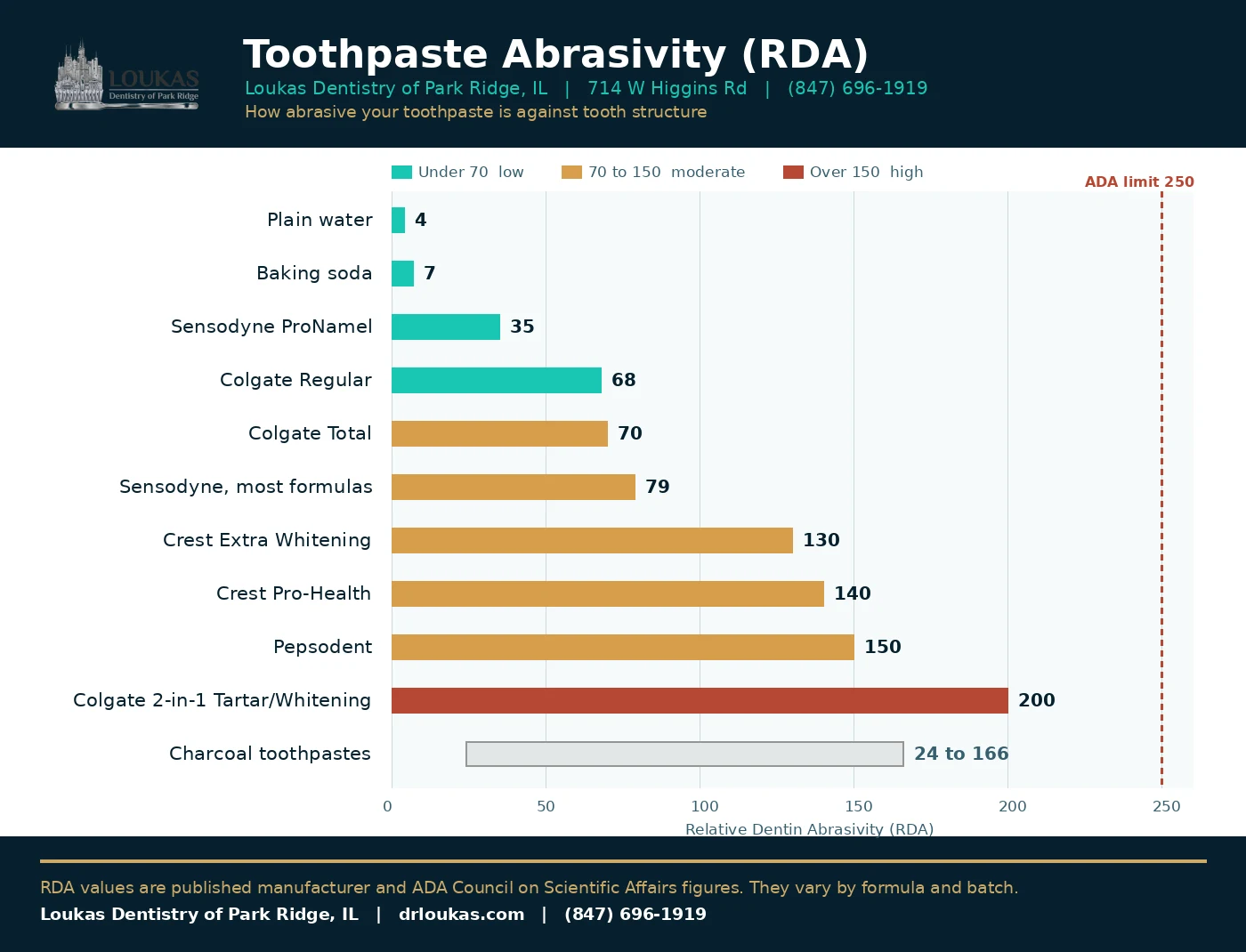
| Toothpaste | RDA | Abrasivity |
|---|---|---|
| Plain water | 4 | Reference point |
| Baking soda | 7 | Reference point |
| Sensodyne ProNamel | 35 | Low |
| Colgate Regular | 68 | Low |
| Colgate Total | 70 | Moderate |
| Sensodyne, most formulas | 79 | Moderate |
| Crest Extra Whitening | 130 | Moderate |
| Crest Pro-Health | 140 | Moderate |
| Pepsodent | 150 | Moderate |
| Colgate 2-in-1 Tartar/Whitening | 200 | High |
| Charcoal toothpastes | 24 to 166 | Varies widely |
Charcoal pastes are the least predictable group on this list. Published values run from gentler than Colgate Regular to close to the most abrasive whitening pastes, and the tube rarely tells you which you bought.
The whitening toothpaste problem
Whitening toothpaste does not bleach the tooth. It scrubs surface stain off, which is why the abrasive load is usually higher. On an intact enamel surface that is a reasonable trade. On an exposed root surface it is not, because root dentin is far softer than enamel and gives way much faster. People with receding gums are often the same people reaching for a whitening paste, which is the worst pairing of the two.
If your goal is a brighter shade rather than stain removal, professional teeth whitening in Park Ridge lightens the tooth itself and costs you no tooth structure.
What Dr. Loukas recommends
- A paste under RDA 70 if you have any gumline notching, sensitivity or recession.
- A soft or extra soft brush. Medium and hard bristles have no advantage and do real harm.
- Light pressure. If the bristles splay outward while you brush, you are pressing far too hard.
- Small circles or short strokes rather than long horizontal scrubbing across the gumline.
- Wait at least 30 minutes after anything acidic. Enamel softens briefly after citrus, soda or wine, and brushing during that window removes more than it would otherwise.
Electric toothbrushes
An electric brush is usually a help rather than a hazard, because most of them have a pressure sensor and because the head does the work for you. The risk is pressing the moving head into the gumline out of habit carried over from a manual brush. Rest it against the tooth and let it run. If your brush has a pressure light, treat it as a rule rather than a suggestion.
How we check for this at your visit
Cervical wear is easy to miss because it is painless until it is not. At a checkup and cleaning we look at the gumline on every tooth, measure recession, and compare against your previous records to see whether a notch is deepening. Shallow wear is managed by changing the paste and the technique. Deeper notches that have reached dentin are usually restored with a tooth colored filling that seals the surface and stops the sensitivity.
If clenching turns out to be part of the picture, that is treated separately. See TMJ and jaw pain treatment in Park Ridge.
Frequently asked questions
Is my toothbrush ruining my teeth?
Not on its own. Laboratory work shows a brush used with water alone does not carve cervical notches. The abrasive in the toothpaste is what removes tooth structure, and pressure and technique decide how fast.
What RDA should I look for?
Under 70 is a sensible target if you already have gumline wear, recession or sensitivity. The ADA permits up to 250, but that is a safety ceiling rather than a recommendation.
Is charcoal toothpaste safe?
It is unpredictable. Published RDA values for charcoal pastes range from about 24 to 166, so two tubes on the same shelf can behave completely differently. Most carry no fluoride either.
Can toothbrush abrasion be reversed?
The lost tooth structure does not grow back. What we can do is stop the wear getting worse and restore the notch with bonding when it is deep or sensitive.
Why are my teeth sensitive to cold at the gumline?
Usually because enamel has worn through to dentin, which carries tubules that run to the nerve. Worth having looked at, because the same symptom can also point to recession, a crack or decay.
Not sure whether your toothpaste is the problem?
Bring the tube to your next visit and we will look at the gumline together. Call (847) 696-1919 or request an appointment. We see patients from Park Ridge, Niles, Des Plaines, Norwood Park and the surrounding area.
Related reading
- Why your toothpaste might be hurting your teeth
- Preventive dentistry in Park Ridge, IL
- Healthy teeth at home guide
References
- Dzakovich JJ, Oslak RR. In vitro reproduction of noncarious cervical lesions. Journal of Prosthetic Dentistry. 2008;100(1):1 to 10.
- Fan J, Caton JG. Occlusal trauma and excessive occlusal forces: narrative review and clinical recommendations. Journal of Periodontology. 2019;90(Suppl 1):S166 to S176.
- American Dental Association, Council on Scientific Affairs. Toothpastes: Relative Dentin Abrasivity values.
- Joiner A. Whitening toothpastes: a review of the literature. Journal of Dentistry. 2010;38(Suppl 2):e17 to e24.