Why Your Toothpaste Might Be Hurting Your Teeth
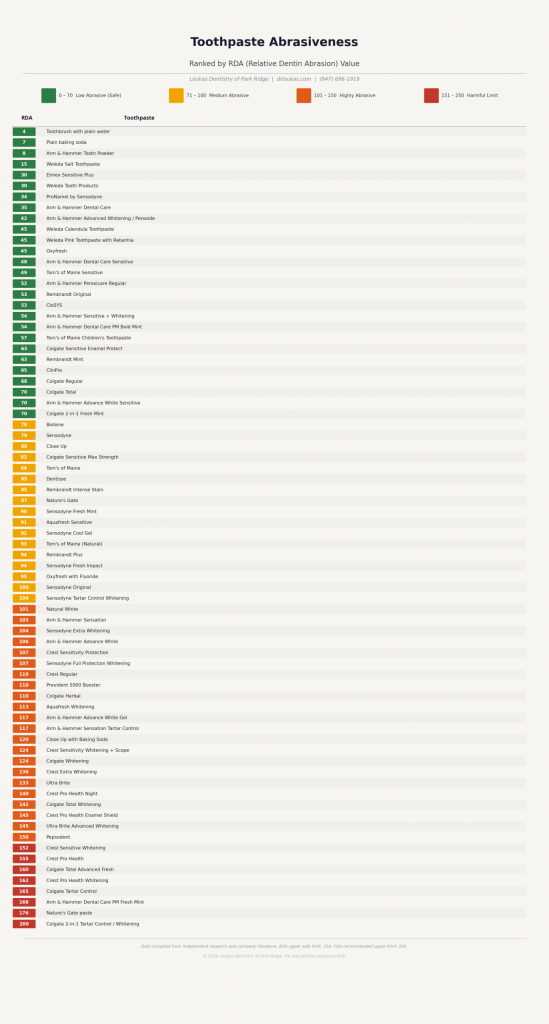
The Toothpaste Problem Nobody Talks About
You brush twice a day, every day. You are doing everything right. But what if the toothpaste you are using is quietly causing damage with every single stroke?
At Loukas Dentistry of Park Ridge, one of the most common findings during routine exams is cervical abrasion — small notches or grooves worn into the teeth at the gumline. Patients are often surprised to hear that their toothpaste is a contributing factor. The mechanism is straightforward: toothpaste contains abrasive particles designed to scrub away plaque and stains, but some formulas are so abrasive that, used daily over months and years, they wear away the very tooth structure they are supposed to protect.
This is not a theory — it is supported by peer-reviewed research. A landmark laboratory study by Dzakovich and Oslak (Journal of Prosthetic Dentistry, 2008) demonstrated that significant non-carious cervical lesions (NCCLs) were produced by horizontal brushing with toothpaste — but brushing with water alone did not create cervical lesions. Toothpaste is responsible for the cervical lesions.
What Is RDA — and Why Does It Matter?
Every toothpaste is assigned an RDA score — Relative Dentin Abrasivity. This international standard measures how aggressively a toothpaste abrades dentin, the layer just beneath your enamel. The scale runs from 0 (no abrasion) to 250 (the upper limit the ADA considers acceptable for daily use).
- RDA 0–70: Low abrasion — ideal for daily use, safe for sensitive teeth and exposed roots
- RDA 70–100: Moderate — acceptable for most healthy adults
- RDA 100–150: High — use with caution, especially if you have recession or sensitivity
- RDA 150–250: Very high — not recommended for daily use by most dental professionals
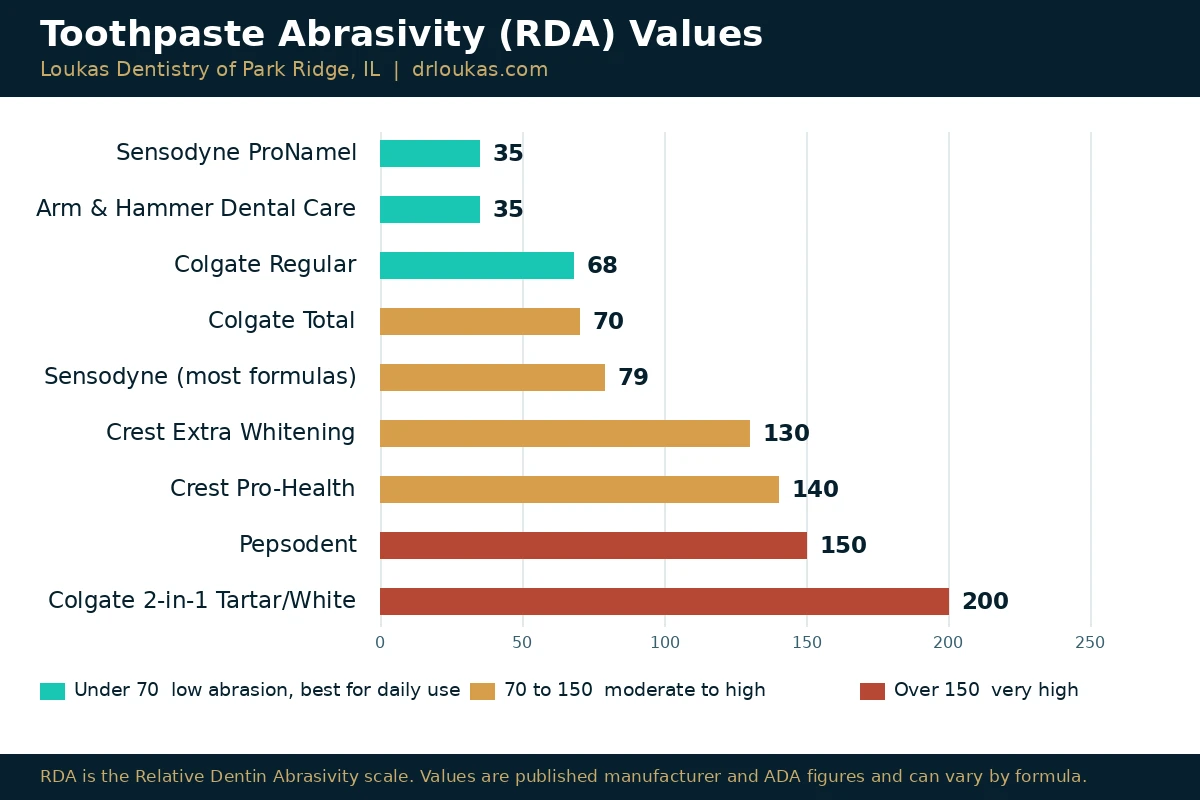
| Toothpaste | RDA Score |
|---|---|
| Sensodyne (most formulas) | 79 |
| Colgate Regular | 68 |
| Colgate Total | 70 |
| Crest Extra Whitening | 130 |
| Crest Pro-Health | 140 |
| Pepsodent | 150 |
| Charcoal toothpastes (varies) | 24–166 |
| Colgate 2-in-1 Tartar/White | 200 |
The ADA allows anything up to 250 for daily use, but that ceiling sits far above what we would actually put in most patients’ hands. A paste at 200 will not harm you in a single brushing. The concern is what it does twice a day for twenty years, at the gumline, where enamel is already at its thinnest.
Clearing Up a Common Myth: Is It Bruxism or Toothpaste?
For decades, some clinicians attributed cervical notching to abfraction — the idea that bite forces and grinding flex the tooth at the gumline. But the science does not support it.
The 2017 AAP/EFP World Workshop on the Classification of Periodontal and Peri-Implant Diseases concluded definitively: “There is no credible evidence to support the existence of abfraction or implicate it as a cause of gingival recession.” (Fan J, Caton JG. Occlusal trauma and excessive occlusal forces. J Periodontol. 2019.)
The notches at your gumline are not from grinding. They are from your toothpaste and how you brush. That is actually good news — because it means the damage is entirely preventable.
The Real Damage: What High-RDA Toothpaste Does to Your Teeth
Abrasion damage is cumulative and permanent. Enamel does not grow back. Here is what happens over time:
1. Cervical abrasion. The gumline is where enamel is thinnest. High-RDA toothpaste wears through this thin layer and begins abrading the softer dentin beneath, creating a characteristic wedge-shaped notch at the base of the tooth.
2. Gingival recession. Abrasive particles and aggressive brushing force the gum tissue to pull back from the tooth, exposing the root surface — which has no enamel protection at all.
3. Sensitivity. Exposed dentin contains microscopic tubules that connect directly to the nerve. When exposed, hot, cold, sweet, and acidic foods can trigger sharp sensitivity.
4. Weakened tooth structure. Over years, repeated abrasion can compromise structural integrity, making teeth more prone to fracture.
The Whitening Toothpaste Trap
Whitening toothpastes are among the most heavily marketed — and among the most abrasive. The “whitening” effect is largely mechanical: abrasive particles scrub surface stains off. Over time, highly abrasive whitening toothpastes can actually make teeth look more yellow, as enamel wears away and the darker dentin beneath becomes more visible.
Charcoal toothpastes present a similar issue. Despite their “natural” marketing, many charcoal formulas have RDA values ranging from 90 to 166, with no clinical evidence of superior whitening.
What Dr. Loukas Recommends
For most patients, we recommend switching to a low-RDA toothpaste (under 70) for daily use:
- Sensodyne ProNamel (RDA ~35): Specifically formulated to protect against acid erosion and abrasion.
- Colgate Regular (RDA 68): A simple, effective formula without unnecessary abrasives.
- Arm & Hammer Dental Care (RDA 35): Low abrasion with baking soda for gentle cleaning.
Brushing Technique Matters Just as Much
Even a low-RDA toothpaste can cause damage if you brush incorrectly. The most common mistake is horizontal scrubbing, which concentrates abrasive force directly at the gumline.
Dr. Loukas recommends the sweeping technique:
- Upper teeth: Place the brush at the gumline and sweep downward toward the biting edge
- Lower teeth: Place the brush at the gumline and sweep upward toward the biting surface
- Always use a soft-bristled brush — medium and hard bristles dramatically increase abrasion risk
A Special Note on Electric Toothbrushes
Sonic brushes like the Philips Sonicare can be excellent tools when used correctly. Key guidelines:
- Use an extremely light grip. The sonic vibration does the work — you are simply guiding the brush along the gumline. Do not press or scrub.
- Move slowly from tooth to tooth, pausing briefly at each one. Do not replicate back-and-forth scrubbing.
- Use a low-RDA toothpaste. High-frequency vibration can drive abrasive particles deeper into the tooth surface.
Rotary and spinning brushes (such as Oral-B oscillating-rotating heads) are not recommended by Dr. Loukas for patients with recession, sensitivity, or thin enamel. The mechanical rotation concentrates abrasive force in a circular pattern at the gumline, which can cause cervical damage over time.
Where This Fits in Your Preventive Care
Toothpaste is one piece of a larger picture. The same exam that catches a notch at your gumline also catches early decay, gum inflammation and wear from clenching, which is why we look at brushing habits as part of preventive dentistry in Park Ridge, IL rather than treating it as a separate conversation.
If you want the full routine written out, our Park Ridge guide to brushing, flossing and diet at home covers technique, timing and the products worth your money. And if your goal is a brighter smile, professional teeth whitening in Park Ridge lightens the tooth itself rather than scrubbing the surface, so it does not carry the abrasion cost that whitening pastes do.
When to See a Dentist
If you notice any of the following, schedule an appointment:
- Sensitivity to cold, heat, or sweets that was not there before
- Visible notching or grooves at the base of your teeth
- Gums that appear to be receding
- Teeth that look more yellow despite regular brushing
At Loukas Dentistry of Park Ridge, we assess every patient’s brushing technique and toothpaste choices as part of our routine exam. Small changes made early can prevent significant damage down the road.
References
- Dzakovich JJ, Oslak RR. In vitro reproduction of noncarious cervical lesions. Journal of Prosthetic Dentistry. 2008;100(1):1–10.
- Fan J, Caton JG. Occlusal trauma and excessive occlusal forces: Narrative review and clinical recommendations. Journal of Periodontology. 2019;90(Suppl 1):S166–S176. (2017 AAP/EFP World Workshop.)
- American Dental Association. Toothpastes: Relative Dentin Abrasivity (RDA) values. ADA Council on Scientific Affairs.
- Joiner A. Whitening toothpastes: A review of the literature. Journal of Dentistry. 2010;38(Suppl 2):e17–e24.
Have questions about your toothpaste or brushing technique? Call us at (847) 696-1919 or request an appointment online. We serve patients in Park Ridge, Niles, Des Plaines, Norwood Park, and the surrounding Chicago area.