Dental Bridges in Park Ridge, IL
Dental Bridges in Park Ridge, IL
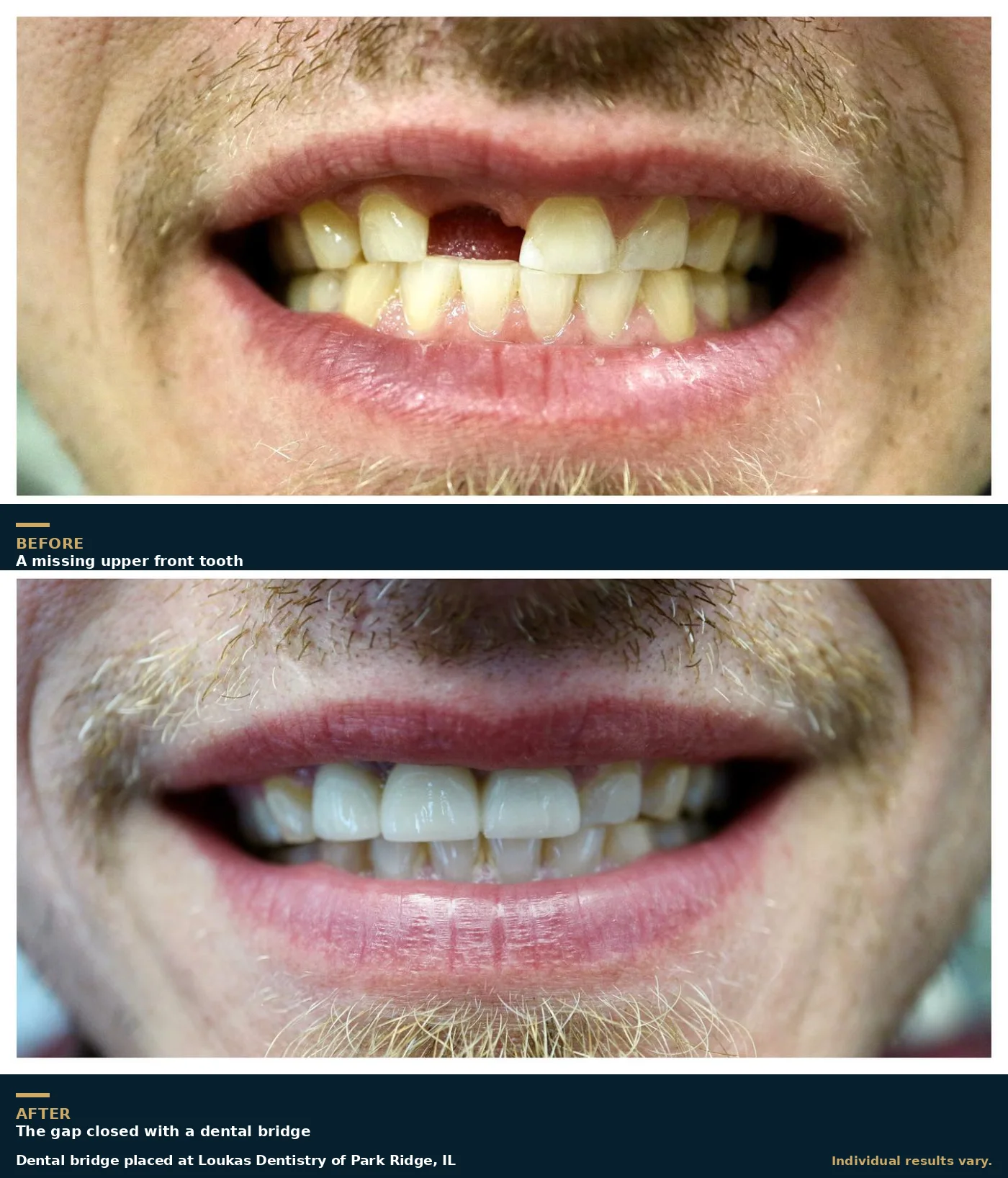
A dental bridge is a fixed, permanent tooth replacement that spans the gap left by one or more missing teeth. Unlike a removable partial denture or implant, a bridge is cemented in place and cannot be removed by you—only by a dentist. It’s a stable, natural-looking solution when your remaining teeth are healthy and well-positioned to support it.
How a Dental Bridge Works
A bridge consists of two or more crowns (called abutment crowns) placed on the healthy teeth on either side of the gap. A false tooth (or teeth), called a pontic, is suspended between these crowns. The entire structure is fabricated as one unit and cemented permanently into place.
Because the bridge is fixed, it feels more like your natural teeth than a removable denture. You brush and floss it just like natural teeth, and there’s no nightly soaking or special handling required.
When Are Dental Bridges Recommended?
A bridge is often the ideal choice when:
- You’re missing one to three consecutive teeth
- The teeth on either side of the gap are strong and healthy (or repairable with a crown)
- You want a fixed, permanent-feeling restoration
- You prefer not to wear a removable appliance
- Bone loss or other factors make implants impractical
- You want a relatively quick solution (faster than implants)
Types of Dental Bridges
Traditional Bridge: Two crowns on the anchor teeth with one or more pontics suspended between them. This is the most common type and works best when you have healthy teeth on both sides of the gap.
Cantilever Bridge: Used when there’s only one healthy tooth adjacent to the gap. The pontic is supported by a single crown on one side. Less common because it places greater force on the single anchor tooth.
Maryland Bridge: A more conservative option with a metal or ceramic framework bonded to the back of the anchor teeth, with minimal tooth preparation. Better for smaller gaps and cases where you want to preserve more of the anchor tooth structure.
Dr. Loukas will recommend the bridge design that best fits your situation and ensures long-term stability.
The Bridge Placement Process
Appointment 1 — Preparation and Impressions: The teeth on either side of the gap are prepared for crowns (a small amount of the outer structure is removed to make room for the crown). We take digital impressions or traditional molds and a bite record. A temporary bridge is fabricated to protect your teeth and gums while the permanent bridge is being made in the lab. This typically takes 2–3 weeks.
Appointment 2 — Delivery and Cementation: Your permanent bridge is tried in to check the fit, bite, and appearance. Any final adjustments are made. Then the bridge is cemented permanently into place with biocompatible dental cement. You’ll feel like your natural teeth have returned.
Care and Maintenance
Oral hygiene is critical: Brush your bridge twice daily with a soft toothbrush. Floss under the pontic daily using a floss threader or water flosser—plaque can accumulate under the bridge if you skip this step, leading to decay in the anchor teeth.
Avoid hard and sticky foods: Don’t chew on ice, hard candy, or tough nuts. Sticky candies can loosen the bridge. Cut food into smaller pieces and chew on your back teeth.
Regular dental visits: See us every six months for cleaning and evaluation. We’ll check the bridge for any signs of loosening, decay under the crown margins, or gum disease around the anchor teeth.
Watch for warning signs: If your bridge feels loose, if there’s discomfort when biting, or if you see dark lines at the gum line (signs of decay), call us right away. Early intervention prevents the need for bridge replacement.
How Long Do Bridges Last?
With good oral hygiene and regular dental care, a bridge typically lasts 10–15 years. Some bridges last 20+ years. The longevity depends on your bite force, how well you maintain the bridge, and the health of your anchor teeth. Eventually, the cement may deteriorate, the anchor tooth may develop decay, or the bridge itself may crack—requiring replacement.
Advantages and Limitations
Advantages: Fixed and permanent-feeling, no special care beyond regular brushing and flossing, relatively fast (completed in two appointments), stable and predictable, no bone loss in the gap area.
Limitations: Requires removal of healthy tooth structure on the anchor teeth (this is irreversible), relies on the long-term health of the anchor teeth, cannot be used if the gap is very wide or if the anchor teeth are weak, more costly than a removable partial denture.
Dental Bridges vs. Other Options
vs. Partial Denture: A bridge is fixed and more natural-feeling but requires grinding down healthy anchor teeth. A partial is removable and preserves your natural teeth but feels less stable and requires nightly care.
vs. Dental Implants: An implant replaces the missing tooth without touching the adjacent teeth, but costs more and takes several months (implants require bone healing before the crown is placed). A bridge is faster and less expensive but requires preparing the anchor teeth.
vs. Doing Nothing: Without a bridge, the remaining teeth shift and tilt into the gap, leading to bite problems, uneven wear, gum disease, and further tooth loss. Replacing missing teeth is an investment in your long-term oral health.
Is a Bridge the Right Choice for You?
Schedule a consultation with Dr. Loukas to evaluate your remaining teeth, your bite, and your restoration goals. We’ll assess whether a bridge, partial denture, implant, or combination approach will work best for your smile and your oral health.
Call (847) 696-1919 or request an appointment to learn more about dental bridges at Loukas Dentistry.
Dental Bridge Questions We Hear in Park Ridge
How long does a dental bridge last?
With good hygiene and regular checkups a bridge commonly lasts a decade or more. What usually ends a bridge is decay in one of the supporting teeth rather than failure of the bridge itself, which is why cleaning under it matters.
Is a bridge better than an implant?
Neither is better in every case. A bridge is faster and does not need surgery, but it requires reshaping the two teeth on either side. An implant stands alone and preserves bone, but takes longer. Our page comparing the two goes through it honestly.
How do I clean under a bridge?
A bridge is joined together, so regular floss will not pass between the units. You use a floss threader or a small interdental brush to clean underneath the false tooth. We show you exactly how at the fitting appointment.
How many visits does a bridge take?
Usually two. At the first the supporting teeth are prepared and impressions or a digital scan are taken, and you leave with a temporary bridge. At the second the permanent bridge is fitted and adjusted.
Does insurance cover a dental bridge?
Most plans treat a bridge as a major restorative service and contribute a percentage, often after a waiting period. We verify your specific benefits before treatment and give you the out of pocket figure in writing.