All-on-4 Dental Implants in Park Ridge, IL
Full-Arch Implant Treatment
All-on-4 Dental Implants in Park Ridge, IL
A fixed full arch of teeth supported by four implants, for patients facing the loss of most or all of their teeth, or living with a denture that no longer holds. Placed and restored in one office by Dr. Thanasi Loukas.
What All-on-4 actually is
All-on-4 replaces a full arch of teeth using four implants rather than one implant per tooth. Two are placed vertically at the front of the jaw, and two are angled at the back to make use of bone that is still dense, which is often what allows treatment to go ahead without extensive grafting first.
A fixed bridge is then secured to those four posts. It does not come out at night. You clean it in the mouth rather than in a glass.
The distinction that matters most to patients is fixed versus removable. A conventional denture rests on the gum and moves. An implant-supported denture snaps onto implants and still comes out. All-on-4 stays in.
A full arch restored on implants
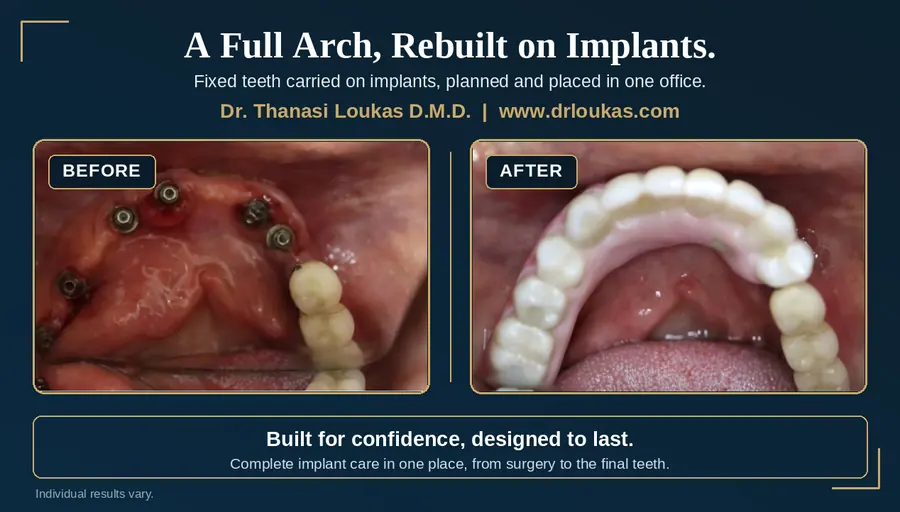
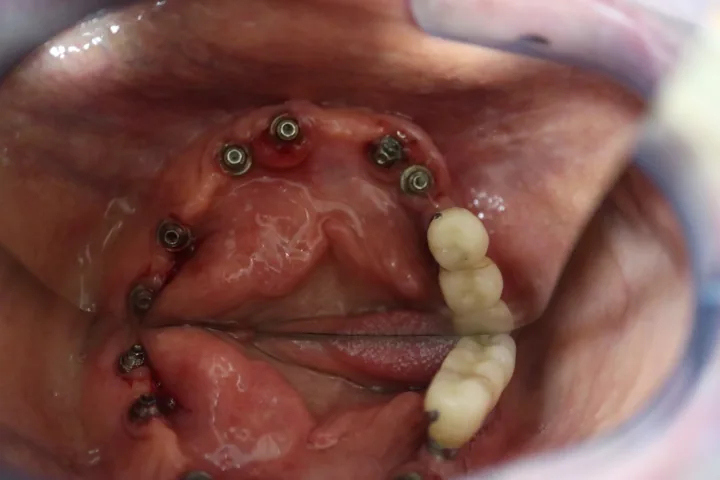
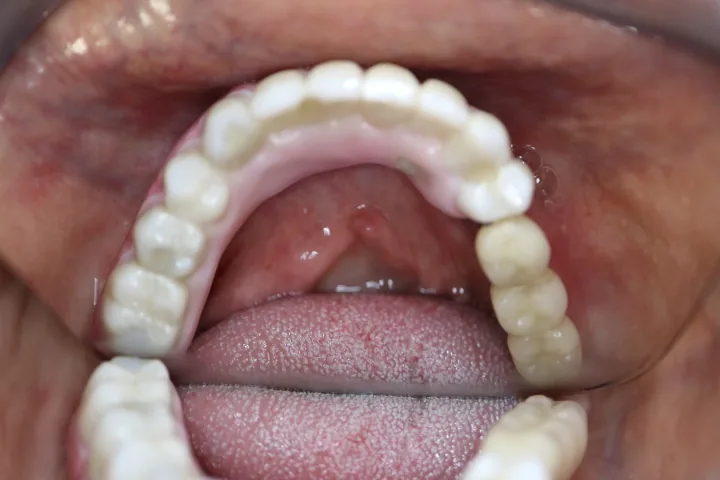
A real case treated at our Park Ridge office. The first photo shows the upper jaw partway through treatment, with the implants placed and the attachments exposed above the gum. The second shows the finished arch of teeth carried on those implants. Every case is different, and the number of implants and the design of the final teeth are decided from your own scan rather than from a template.
Who it suits, and who it does not
Often a good fit
Most or all teeth failing in an arch, advanced gum disease with mobile teeth, or a lower denture that has never felt secure no matter how many relines it has had.
Sometimes better served otherwise
If only a few teeth are missing, individual implants or a bridge usually preserve more of what you still have. More implants is not automatically better care.
Needs assessment first
Severe bone loss, uncontrolled diabetes, heavy smoking and some medications all affect healing and success rates. These are discussed openly, not glossed over.
May need groundwork
Where bone is insufficient even for angled placement, grafting can build the foundation first, which lengthens the overall timeline.
The honest answer to whether All-on-4 is right for you comes from a CBCT scan showing your actual bone, not from a webpage. That consultation is free.
Fixed teeth, snap-in dentures, or a conventional denture
Most people arriving at this page have been told they will lose most or all of the teeth in an arch, and are trying to work out which of three routes to take. This is the honest comparison, including where All-on-4 is not the right answer.
| All-on-4 fixed bridge | Snap-in implant denture | Conventional denture | |
|---|---|---|---|
| Does it come out? | No. It stays in permanently and only your dentist removes it. | Yes. You take it out to clean it. | Yes. |
| What holds it | Four to six implants anchored in bone. | Two to four implants with locator attachments. | Suction, the gum ridge, and often adhesive. |
| Roof of the mouth | Left open on an upper arch, so taste and temperature come through normally. | Usually partly covered. | Fully covered on an upper arch. |
| Biting force | Closest to natural teeth of the three. | Considerably firmer than a conventional denture. | The most limited, and it tends to reduce over time. |
| Cleaning | Cleaned in the mouth, around and under the bridge, with a water flosser. | Taken out and cleaned, attachments wiped. | Taken out and cleaned. |
| Effect on bone | Implants load the bone where they are placed, which helps maintain it there. | Same benefit at the implant sites. | Bone under a denture continues to shrink, which is why dentures need relining. |
| Relative cost | Highest of the three. | In between. | Lowest. |
| Often the better choice when | You want teeth that never move and you are prepared for the surgical and financial commitment. | You want real stability at a lower cost, and do not mind a prosthesis that comes out. See implant supported dentures. | Cost is the deciding factor, or health considerations rule out surgery for now. |
If you are weighing implants against dentures more broadly, our dental implants compared with dentures guide covers the same ground for partial tooth loss.
If you have been told you need everything taken out
Very few people arrive asking for All-on-4 by name. Most describe it differently, and all of these describe the same treatment or one close to it.
- Permanent teeth that do not come out at night
- Teeth fixed to implants instead of a plate that moves
- Replacing a full upper or lower set after years of failing teeth
- Getting out of a denture that has been relined repeatedly and still will not hold
- Being told there is not enough bone for individual implants across the arch
If any of those sound like your situation, a consultation is the right next step whether or not All-on-4 turns out to be the treatment. What matters at that visit is the CBCT scan, because bone volume determines which options are genuinely open to you. Dr. Thanasi Loukas places and restores implants in this office, so the plan and the surgery are not split between two practices.
How treatment runs
- Consultation and 3D imaging. CBCT scanning and digital impressions map bone volume, nerve position and your bite before anything is committed to.
- Planning. Implant positions are planned against the final tooth design, so the teeth drive the surgery rather than the other way round.
- Surgery day. Failing teeth are removed, implants are placed, and a provisional fixed bridge is fitted. Sedation is available.
- Healing. The implants integrate with bone over several months. You eat a softer diet during this period and are seen for review.
- Final bridge. Once integration is confirmed, the definitive bridge is made and fitted.
- Maintenance. Regular hygiene visits. Implants do not decay, but the gum and bone around them still need looking after.
Anyone promising a permanent final result in a single day is describing the provisional stage, not the finished one.
What it costs
Full-arch treatment is quoted individually, because the number of extractions, whether grafting is required, and the materials chosen for the final bridge all move the figure substantially. We will not put a headline number here that turns out not to apply to you.
For context, a single implant in this area typically runs $3,000 to $5,000 complete, and bone grafting ranges from roughly $300 to $3,000 depending on the procedure. Our dental implant cost guide explains what drives those numbers.
You will get a written treatment plan with your figure before starting. CareCredit and in-office payment plans are available, including promotional periods with no interest when paid in full within the term.
Frequently asked questions
Will they feel like real teeth?
Closer than a denture, by a wide margin. Because the bridge is anchored to bone rather than resting on gum, biting force is far greater and there is no palate coverage on the upper arch, so taste and temperature come through normally. It is still a prosthesis, and there is an adjustment period.
How long do All-on-4 implants last?
The implants themselves are designed to be permanent and frequently last decades with good hygiene. The bridge attached to them is a wearing part and may need refurbishment or replacement over a long enough period, much like any restoration.
Is the surgery painful?
The procedure is done under local anaesthetic with sedation available, so you should not feel pain during it. Afterwards expect swelling and soreness for several days, managed with medication and clear aftercare instructions.
Can I have All-on-4 on just one arch?
Yes. Many patients treat the lower arch, where dentures are least stable, and keep or separately restore the upper.
What if I already have a denture?
That is a common starting point. Bring it with you. Sometimes the existing denture can serve as a temporary during treatment, and it also tells us a great deal about your bite and what has been going wrong.
Find out where you actually stand
Implant consultations are free and include a proper look at your bone. You will leave knowing which options are genuinely open to you.
Related treatment