Advanced Dental Technology in Park Ridge, IL
Better technology is not about gadgets. It is about seeing more before we treat, so the treatment itself is smaller, faster and more predictable. At Loukas Dentistry of Park Ridge, Dr. Thanasi Loukas and Dr. Maria Loukas use 3D cone beam imaging, near-infrared cavity detection and fully digital impressions to diagnose accurately and plan precisely — often catching problems while they are still small enough to fix simply.
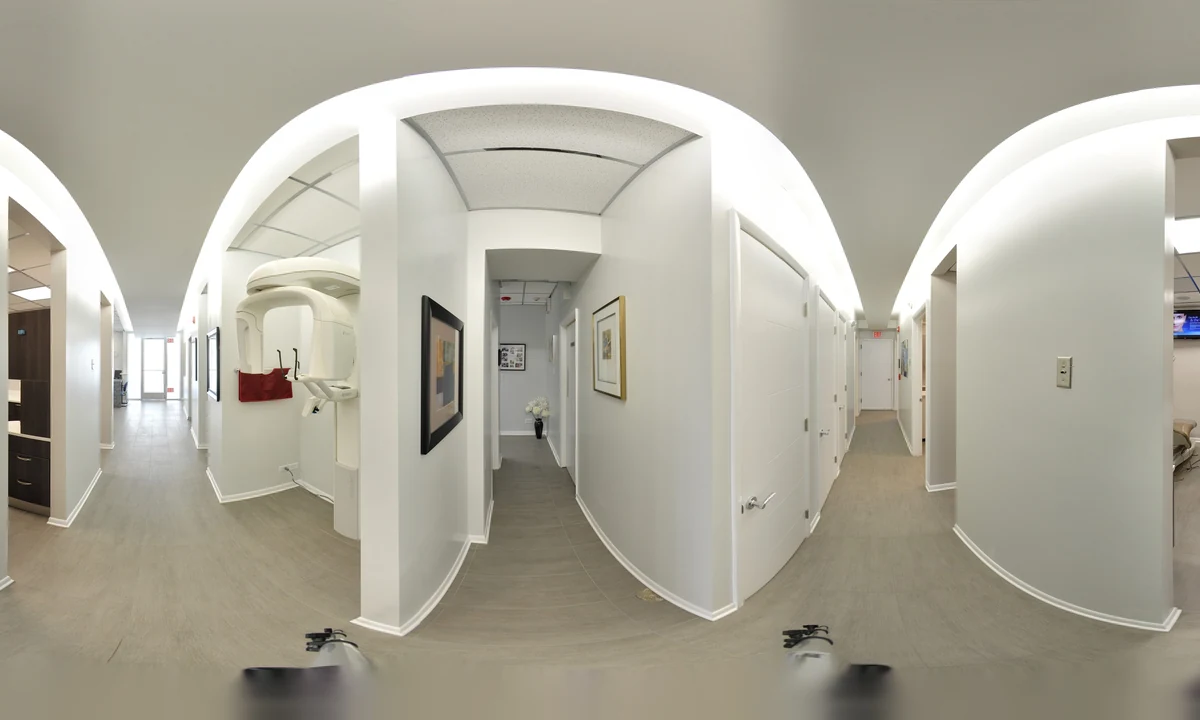
PreXion 3D Excelsior Pro CBCT Scanner
Cone Beam Computed Tomography (CBCT) produces a true three-dimensional image of your teeth, jawbone, sinuses, nerve pathways and airway. A conventional dental X-ray flattens all of that into two dimensions. A CBCT scan lets us rotate through your anatomy slice by slice and measure it — bone height and width to the tenth of a millimetre, the exact path of the inferior alveolar nerve, the true shape of a root canal system.
Our PreXion 3D Excelsior Pro captures with a 0.3 mm focal spot and voxel resolution down to 0.08 mm, which is what makes fine structures like accessory canals and thin bone walls readable. It offers several acquisition modes, from a rapid low-dose scan of roughly five seconds to an ultra-high-definition scan for the most detailed diagnostic work, so we can match the scan to the clinical question instead of always using maximum exposure. Field of view is selectable too — we image the region we need rather than the whole skull.
Used for: dental implant planning, wisdom teeth and impacted tooth assessment, root canal diagnosis, TMJ evaluation, airway analysis, pathology and bone grafting assessment
Panoramic and Digital X-Rays
The same PreXion unit produces panoramic images — a single wide view of both jaws, all the teeth, the sinuses and both TMJ joints. A panoramic is the right first look for wisdom teeth, developing teeth in children, jaw fractures and anything where we need the whole picture before deciding whether a 3D scan is warranted.
For everyday diagnosis we use digital intraoral sensors rather than film. The image appears on the screen beside you within seconds, it can be magnified and contrast-adjusted rather than held up to a light box, and it requires meaningfully less radiation than the film it replaced. Nothing is developed with chemicals and nothing gets lost in a paper chart.
Used for: routine decay and bone-level checks, wisdom teeth screening, pre-treatment records, monitoring changes between visits
iTero Element 5D Plus Scanner — With NIRI Cavity Detection
This is the piece of equipment most patients notice, and the one that changes the visit most.
Digital impressions instead of putty. A small wand passes over your teeth and builds an exact 3D model on screen. No tray, no impression material, no gagging, and no remakes because the material distorted. That model drives Invisalign treatment, crowns, veneers, night guards and implant restorations.
NIRI — near-infrared imaging. While it scans, the iTero 5D Plus also shines near-infrared light through your tooth structure. Enamel is largely transparent to that wavelength; decay is not, so early interproximal cavities — the ones between teeth, where a mirror cannot reach — show up as dark shadows on the screen. It uses no radiation at all, so we can look between your teeth as often as we like, including at every hygiene visit.
An honest caveat: NIRI images the crown of the tooth above the gumline. It aids in finding and monitoring early interproximal decay, and it works alongside your X-rays rather than replacing them — we still need radiographs to see root surfaces, bone levels, infections and anything below the gum. What NIRI changes is how early we catch a cavity between the teeth, and how comfortably we can watch a questionable spot over time instead of drilling to find out.
Also on board: the Invisalign Outcome Simulator, which shows you a projection of your finished smile before you commit, and iTero TimeLapse, which overlays today’s scan on previous ones to show gum recession, tooth wear and movement you would never notice yourself.
Intraoral Cameras
A pen-sized camera puts a magnified, high-definition image of a single tooth on the monitor in front of you. It is the difference between being told you have a cracked filling and seeing the crack yourself.
We use it deliberately, because informed patients make better decisions. If we recommend a crown, you should be able to see why. If we recommend waiting and watching instead, you should be able to see that too — and compare the same tooth six months later.
Benefits: you see what we see, earlier detection of cracks and failing restorations, visual documentation for insurance claims, side-by-side comparison over time
Guided Implant Surgery
This is where the CBCT and the iTero come together. We merge the 3D bone scan with the digital surface scan of your teeth into one file, then plan the implant virtually — choosing its exact position, angle and depth relative to the nerve, the sinus and the tooth that will eventually sit on top of it.
From that plan we produce a custom surgical guide that fits over your teeth and directs the drill precisely along the planned path. The implant goes where it was designed to go, not where it happened to end up. Dr. Loukas both places and restores implants in this office, so the surgical plan and the final crown are designed by the same person.
Benefits: more predictable positioning, shorter time in the chair, smaller incisions in suitable cases, restorations that fit as designed
3D Airway Analysis
A CBCT scan captures your airway as a three-dimensional volume, which means we can measure its narrowest point rather than guess at it. Patients who snore, wake unrefreshed, grind their teeth or have a scalloped tongue often turn out to have a measurably constricted airway.
We are not sleep physicians and we do not diagnose sleep apnea — that requires a sleep study. What we can do is measure, show you the numbers, and either fit a custom oral appliance or refer you to a sleep specialist with objective imaging already in hand.
Technology Questions Patients Ask
Can you find cavities without X-rays?
Partly. Our iTero Element 5D Plus uses near-infrared imaging (NIRI) to look for early decay between teeth above the gumline, with no radiation at all. It is a genuine aid for finding and monitoring those interproximal cavities. It does not replace X-rays, which remain necessary to see below the gumline, at the roots and in the bone. In practice the two work together, and NIRI lets us check between your teeth more often than we could justify with radiographs alone.
Is a CBCT scan safe? How much radiation is involved?
A dental CBCT scan uses considerably less radiation than a medical CT of the same region. Our PreXion offers several modes, including a rapid low-dose scan of about five seconds, and we select the smallest field of view that answers the clinical question rather than scanning more than we need. We also only take a CBCT when it will change the treatment plan — for implant planning, impacted teeth, complex root canals or airway assessment. It is not part of a routine checkup.
Do I still have to bite into that putty impression material?
For the overwhelming majority of cases, no. The iTero scanner captures a digital model with a small wand, which takes a few minutes and involves nothing to gag on. Crowns, veneers, Invisalign, night guards and implant restorations are all designed from the digital scan.
Do I need a referral to get a CBCT scan here?
No. We image and interpret in-office as part of your treatment planning, so you are not sent to a separate imaging centre and back. If you have been referred to us by another dentist or specialist for imaging, we are happy to help — call (847) 696-1919.
Is any of this technology suitable for children?
NIRI is particularly useful with children and anxious patients, because checking between the teeth involves no radiation and nothing sharp. The intraoral camera also helps a child understand why a tooth needs attention. Learn more about kids dentistry at our Park Ridge office.
Can I see my Invisalign result before I start?
Yes. The iTero Element 5D Plus includes the Invisalign Outcome Simulator, which projects your likely finished smile from your own scan during the consultation. It is a simulation rather than a guarantee, but it makes the decision a lot less abstract. See Invisalign vs. braces for how the treatments compare.
See the Technology for Yourself
New patients are welcome at our Park Ridge office at 714 W Higgins Rd. Ask us to scan your teeth and show you what we see.