PDO Thread Lift in Park Ridge, IL
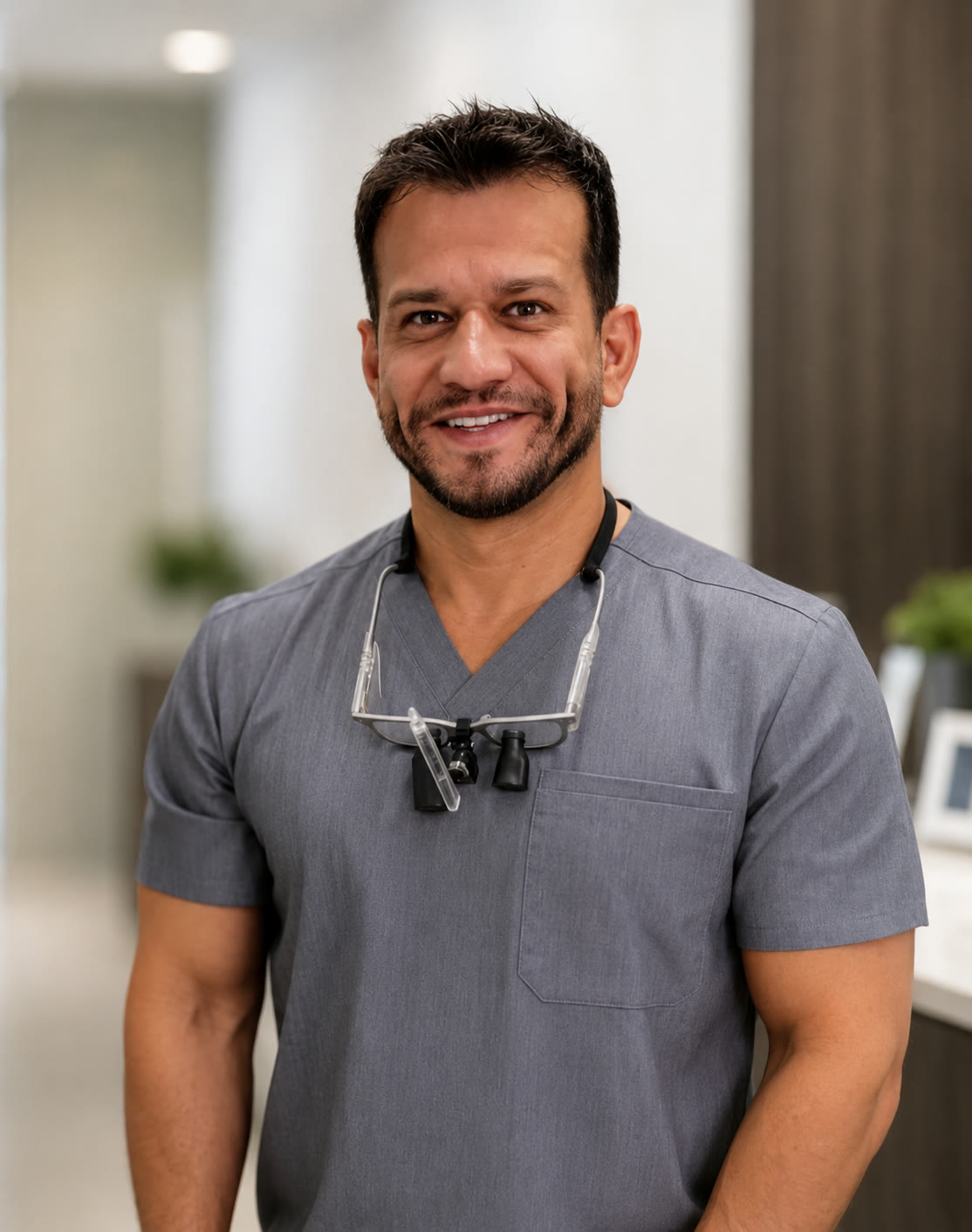
A PDO thread lift lifts and tightens sagging skin on the face and neck without surgery, without general anaesthetic and without the weeks of recovery a facelift demands. Dr. Thanasi Loukas has been placing PDO threads at Loukas Dentistry in Park Ridge since 2020, alongside Botox, dermal filler and Kybella, and every treatment is performed by Dr. Loukas himself — not delegated to a technician.
PDO lifting and soft threads are placed by Dr. Thanasi Loukas, DMD, who trained in thread lifting and facial aesthetics through the American Academy of Facial Aesthetics.
There Are Two Kinds of PDO Thread — and the Difference Matters
Most pages about thread lifts blur the two together. They do quite different jobs, and a good result usually means choosing correctly between them — or using both.
Lifting threads (barbed)
These carry tiny cones or barbs along their length. Once placed in the fat layer, the barbs catch the tissue, and the thread is drawn upward to physically reposition it. This is the closest thing to a facelift that does not involve a scalpel. Best for jowls, a softening jawline, mid-face descent and heavy nasolabial folds.
Soft threads (smooth)
These have no barbs and do not pull anything. They are placed in a mesh pattern to provoke collagen where skin has thinned. Best for fine lines, crepey texture, the neck, a subtle brow or “cat eye” lift, and defining the lip border. They are also what we use to tighten skin after Kybella has dissolved fat under the chin.
What the Threads Actually Do to Your Skin
Polydioxanone has been used as absorbable surgical suture for decades, which is why its safety profile is so well understood. What makes it useful cosmetically is the reaction it provokes: the presence of the thread signals your fibroblasts — the cells that build collagen — to start producing again in that area.
Collagen is the scaffolding under the skin that keeps it full and springy. It declines steadily from our twenties onward, and that decline is most of what we recognise as an ageing face: flatter cheeks, a less defined jaw, folds at the corners of the mouth, skin that creases even at rest. PDO threads are one of the few treatments that address that cause rather than only its surface. The thread itself dissolves; the collagen it triggered is yours.
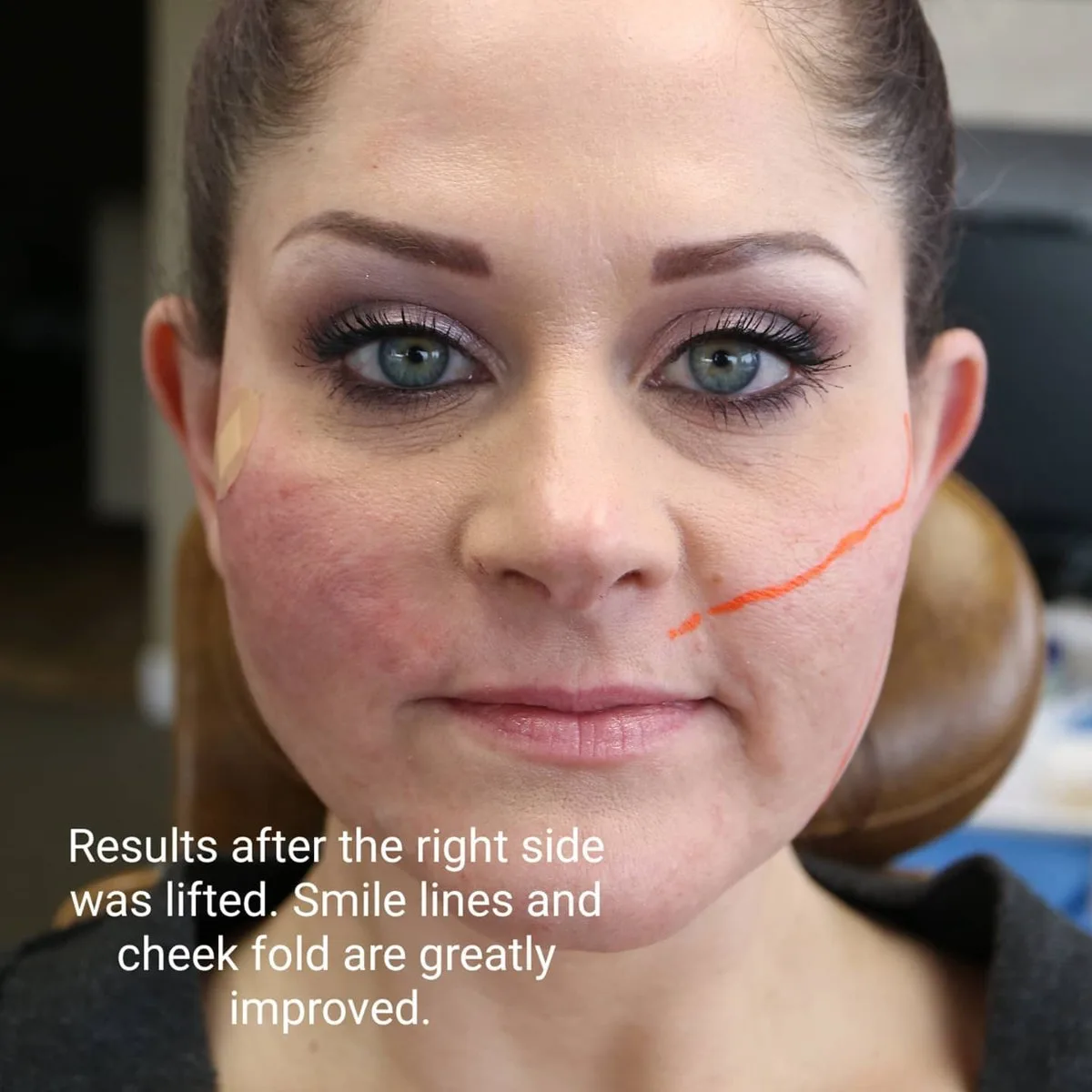
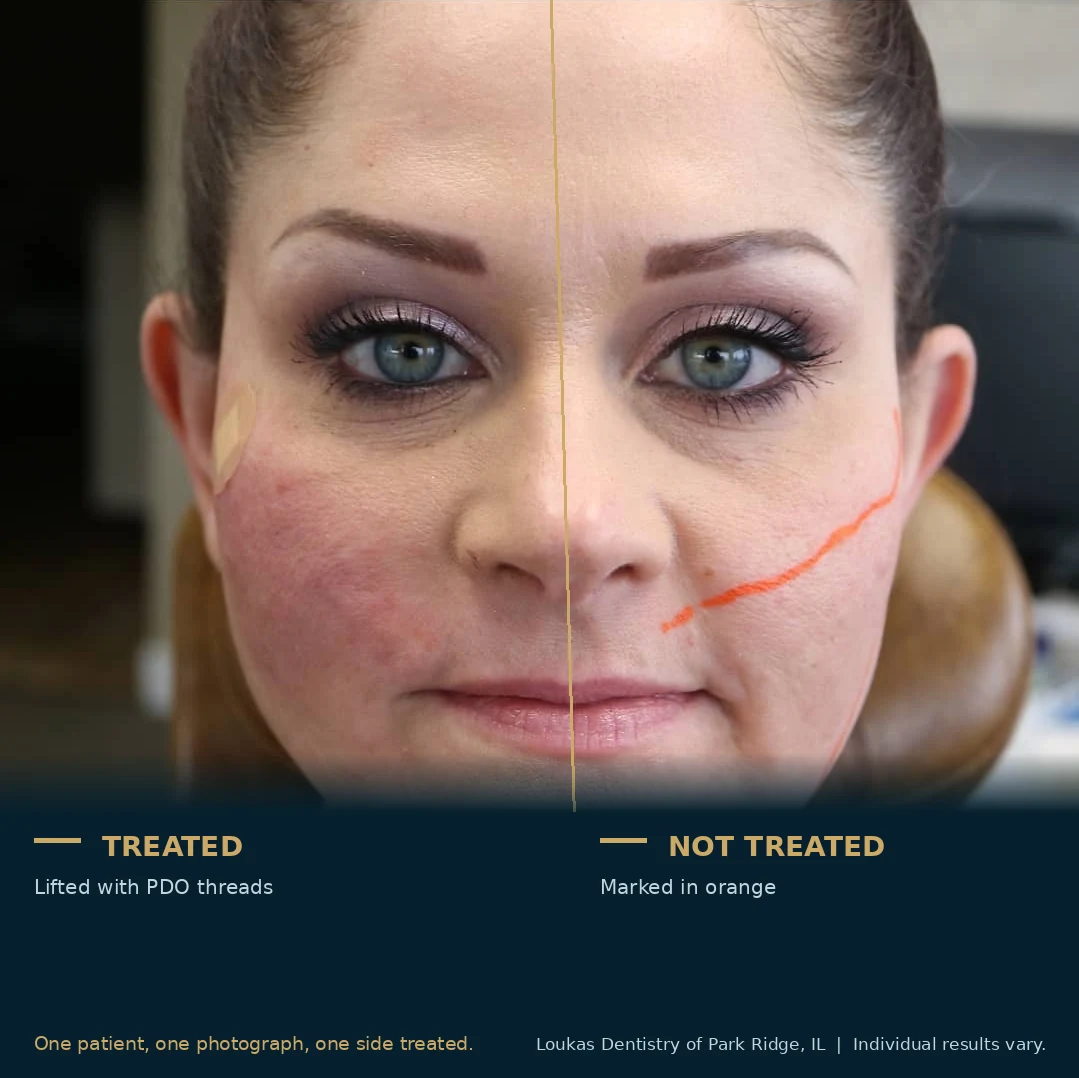
One side lifted, the other not yet treated. The smile line and cheek fold on the treated side sit visibly higher — the clearest way to see what threads do, because the patient is her own control.
Seeing it on one side first
When we treat a face with lifting threads we often complete one side and pause so the patient can look in the mirror before we do the other. It is the most honest demonstration available: same face, same lighting, same day. What you are judging is the treatment, not a change of hairstyle or camera angle.
It also settles expectations. A thread lift produces a real but moderate lift. If you are hoping for the result a surgical facelift gives, this photograph is the point at which we would tell you so.
What the Appointment Is Actually Like
- Planning. Dr. Loukas marks the vectors on your skin — the direction each thread will travel and where it will anchor. This is the part that determines whether the result looks natural.
- Numbing. Topical anaesthetic, then small injections of local anaesthetic at the entry points. As a dentist, Dr. Loukas gives facial local anaesthetic every working day; most patients find this the least eventful part of the visit.
- Placement. The thread is introduced through a tiny entry point on a fine needle or cannula and passed through the fat layer along the planned vector.
- The lift. With barbed threads, the tissue is drawn up along the thread until it sits where it was planned to sit.
- Trimming. The ends are cut below the skin surface. Nothing protrudes and there is nothing to see afterward.
Most full-face thread appointments run 45 to 60 minutes. You walk out; there is no sedation and no one needs to drive you home.
See it happen. We filmed a thread placement in our Park Ridge treatment room, so you can watch exactly what step three looks like before you book. Watch PDO threads being placed in Park Ridge, IL.
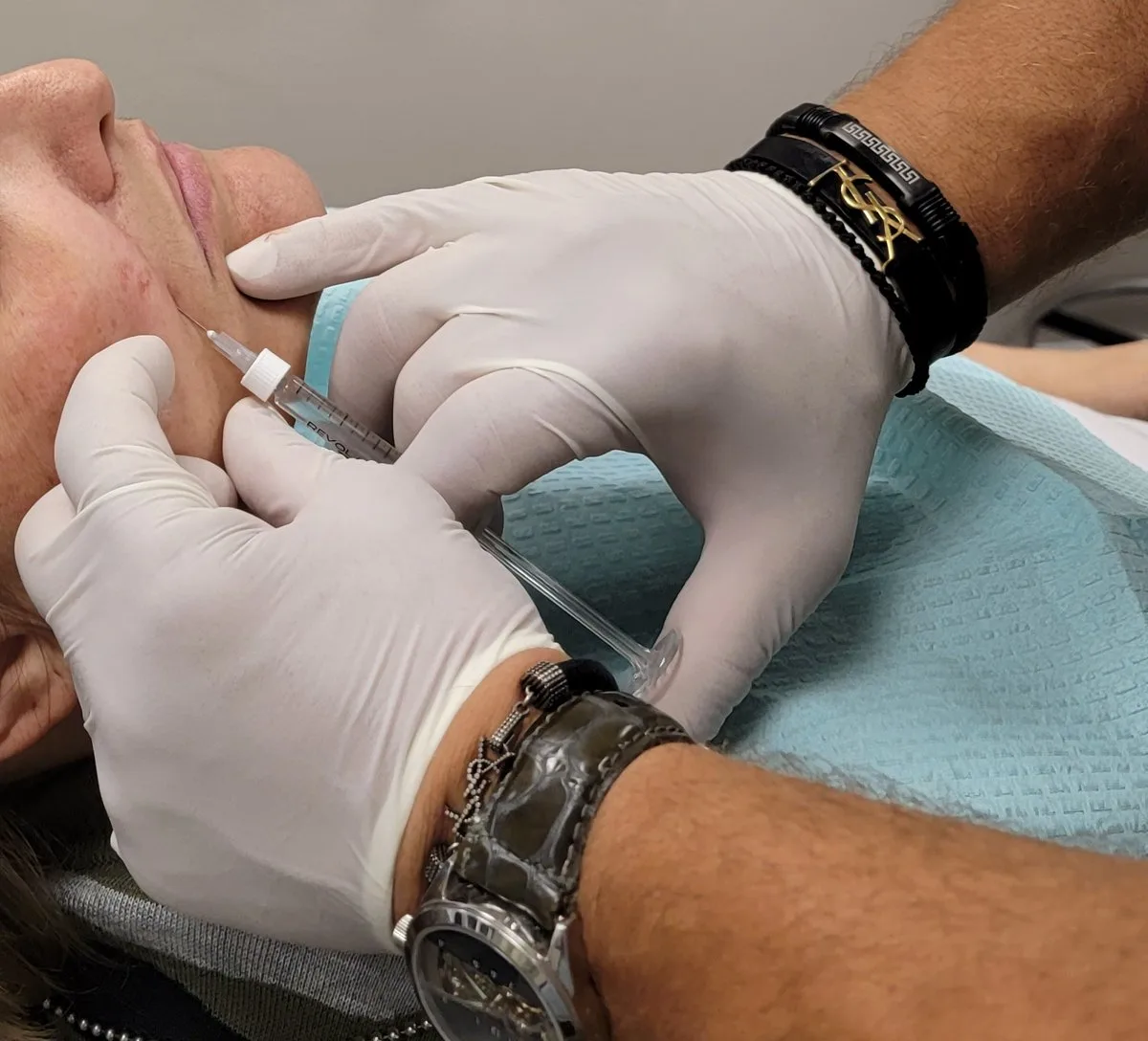
Dr. Loukas placing threads along the lower face in our Park Ridge treatment room.
PDO Threads for Lip Definition
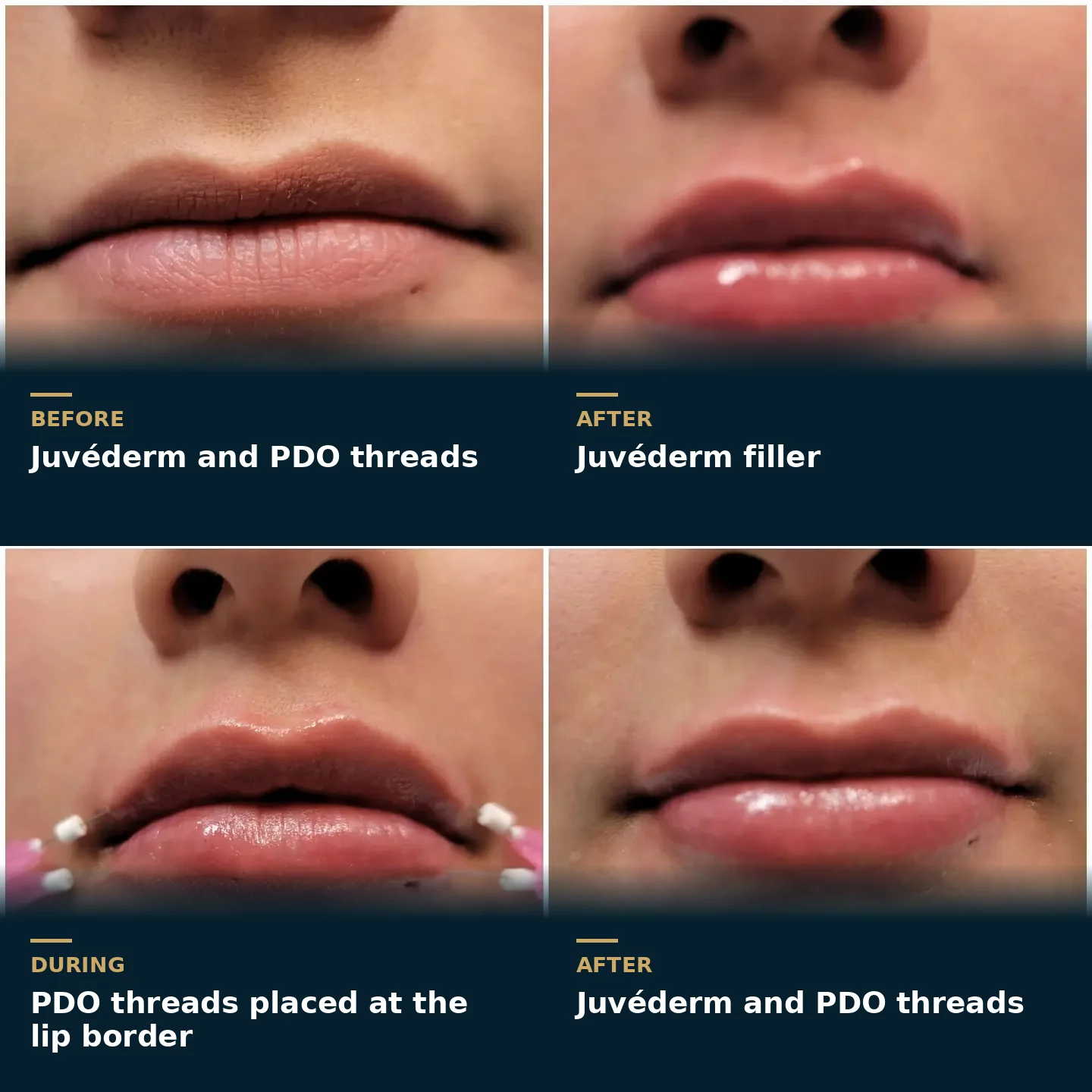
Before treatment, after Juvéderm alone, threads being placed along the vermilion border, and the finished result.
This is the use of PDO threads people know least about, and one of the most satisfying. Filler adds volume to the body of the lip. It does not sharpen the border — the crisp edge where lip meets skin, which softens with age and is much of what makes a young mouth read as young.
Fine soft threads placed along the vermilion border restore that definition, so the outline of the lip lifts and reads clearly. Used together with Juvéderm, you get volume and edge rather than volume alone, which is usually what a patient means when they say they want fuller lips but not obviously treated ones.
See our lip filler page for how the two treatments are planned together.
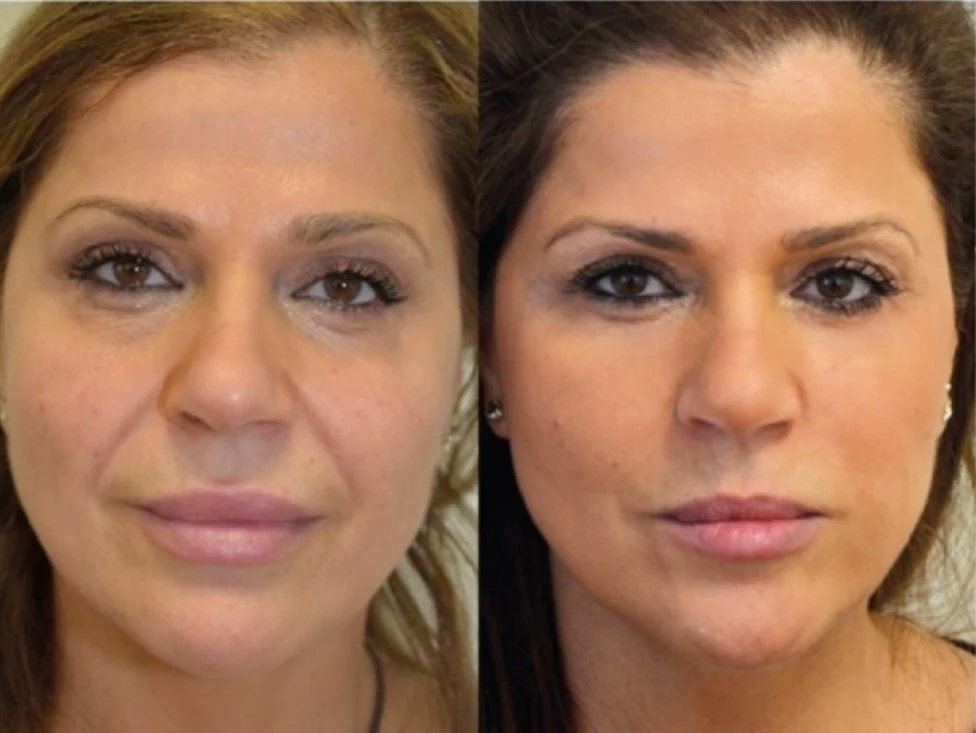
Areas We Treat
Are You a Good Candidate?
Thread lifts work best on early and moderate laxity. The ideal patient is someone who can see the beginning of a jowl, a fold that has deepened, or a jawline that is no longer quite as defined — and who wants that addressed before it becomes a surgical problem.
If your skin laxity is advanced, threads will not give you the result you want, and we will say so at the consultation rather than after you have paid for them. Heavily sagging tissue needs a surgical facelift, and we will refer you to a plastic surgeon. Turning away a case that threads cannot fix is not a lost sale; putting threads into one is a disappointed patient.
Threads are also a poor choice if you are pregnant or breastfeeding, have an active skin infection in the treatment area, or have an autoimmune or bleeding disorder that has not been discussed with your physician.
Recovery and Aftercare
Most people go back to ordinary daily activity straight away and feel back to normal within one to two weeks. Expect some swelling, and possibly bruising at the entry points, for the first several days. A feeling of tightness when you open wide or smile broadly is normal and settles as the tissue relaxes around the threads.
- Sleep on your back, head slightly elevated, for the first week
- Avoid facial massage, facials and dermal rolling for two to three weeks
- Skip strenuous exercise, saunas and hot yoga for about a week
- Keep big facial movements — wide yawning, heavy chewing of tough food — modest for the first few days
- Cleanse gently and keep the skin moisturised
- Schedule elective dental work, which requires opening wide for long periods, outside the first two weeks
Occasionally the skin puckers slightly over a thread in the first days. This almost always settles on its own; if it does not, it is easily corrected — call us rather than waiting.
How Long Results Last
The lift is visible immediately, then improves over the following six to twelve weeks as new collagen forms. The threads themselves absorb over several months. Most patients keep a worthwhile result for around 12 to 18 months, and some longer — how quickly your body metabolises the material makes a real difference. Many people choose to re-treat annually, and results tend to build rather than reset, because each round leaves collagen behind.
Combining Threads With Other Treatments
Threads reposition tissue. They do not soften a muscle and they do not replace lost volume, so they are frequently planned alongside other treatments:
- Botox for dynamic lines — forehead, frown lines, crow’s feet — that threads do not address
- Dermal filler to restore volume in the cheek or lip while threads provide lift and definition
- Kybella to dissolve fat beneath the chin, followed by soft threads to tighten the skin left behind — the combination that avoids trading a double chin for loose skin
Why a Dentist Is Doing This
It is a fair question, and the answer is a good one. Dentists spend their entire careers working in the head and neck, injecting local anaesthetic into the face daily, and reading the facial anatomy — the nerve pathways, the vessels, the fat compartments, the muscles of expression — that thread placement depends on. Dr. Loukas has additional training in facial aesthetics through the American Academy of Facial Aesthetics.
There is also a practical advantage: the lower face is a single system. The way your teeth meet, the volume in your lips, the position of your jawline and the tone of the muscles around your mouth all affect each other. Planning threads in the same chair where your bite and smile are already known produces a more coherent result than treating the skin in isolation.
PDO Thread Lift Questions We Are Asked
Does a PDO thread lift hurt?
The area is fully numbed with topical and local anaesthetic before anything is placed, so the placement itself is not painful. Most patients describe pressure and a pulling sensation rather than pain. Afterward, expect tenderness and tightness for a few days, manageable with paracetamol or ibuprofen.
Will anyone be able to see the threads?
No. The threads sit beneath the skin and the ends are trimmed below the surface. Entry points are needle-sized and typically invisible within a few days.
How is this different from a surgical facelift?
A facelift removes excess skin and repositions deeper structures, under general anaesthetic, with incisions, a surgical recovery and results lasting many years. A thread lift repositions tissue without removing anything, takes about an hour, and lasts a year or so. It produces a smaller change for a much smaller commitment. It is not a cheaper facelift; it is a different treatment aimed at an earlier stage.
What does a PDO thread lift cost in Park Ridge?
Cost depends on how many threads are needed, which type, and how many areas are treated — a lip border is a very different quotation from a full lower face and neck. We give you an exact figure at the consultation before anything is booked, and we will tell you if we think the money is better spent on a different treatment. Call (847) 696-1919 to arrange one.
Can I have threads and Botox at the same visit?
Usually yes, and it is common. Dr. Loukas will sequence them within the appointment. Filler is sometimes staged to a separate visit depending on the areas involved.
What are the risks?
The common effects are swelling, bruising and temporary tightness. Less commonly, skin can dimple or pucker over a thread, or the two sides can settle slightly unevenly — both are correctable. Rarely, a thread can migrate or extrude, or an entry point can become infected. Dr. Loukas will go through all of this with you before you consent, not after.
How soon can I go back to work?
Most patients return the next day. If you bruise easily or you have a significant event coming up, allow two weeks between the treatment and the event.
Book a PDO Thread Consultation
Dr. Loukas will assess your skin, tell you honestly whether threads are the right treatment, and quote you before anything is scheduled. We are at 714 W Higgins Rd, Park Ridge, IL 60068.
Schedule a Consultation Call (847) 696-1919