Why Your Toothpaste Might Be Hurting Your Teeth

The Toothpaste Problem Nobody Talks About

You brush twice a day, every day. You are doing everything right. But what if the toothpaste you are using is quietly causing damage with every single stroke?

At Loukas Dentistry of Park Ridge, one of the most common findings during routine exams is cervical abrasion — small notches or grooves worn into the teeth at the gumline. Patients are often surprised to hear that their toothpaste is a contributing factor. The mechanism is straightforward: toothpaste contains abrasive particles designed to scrub away plaque and stains, but some formulas are so abrasive that, used daily over months and years, they wear away the very tooth structure they are supposed to protect.

This is not a theory — it is supported by peer-reviewed research. A landmark laboratory study by Dzakovich and Oslak (Journal of Prosthetic Dentistry, 2008) demonstrated that significant non-carious cervical lesions (NCCLs) were produced by horizontal brushing with toothpaste — but brushing with water alone did not create cervical lesions. Toothpaste is responsible for the cervical lesions.


What Is RDA — and Why Does It Matter?

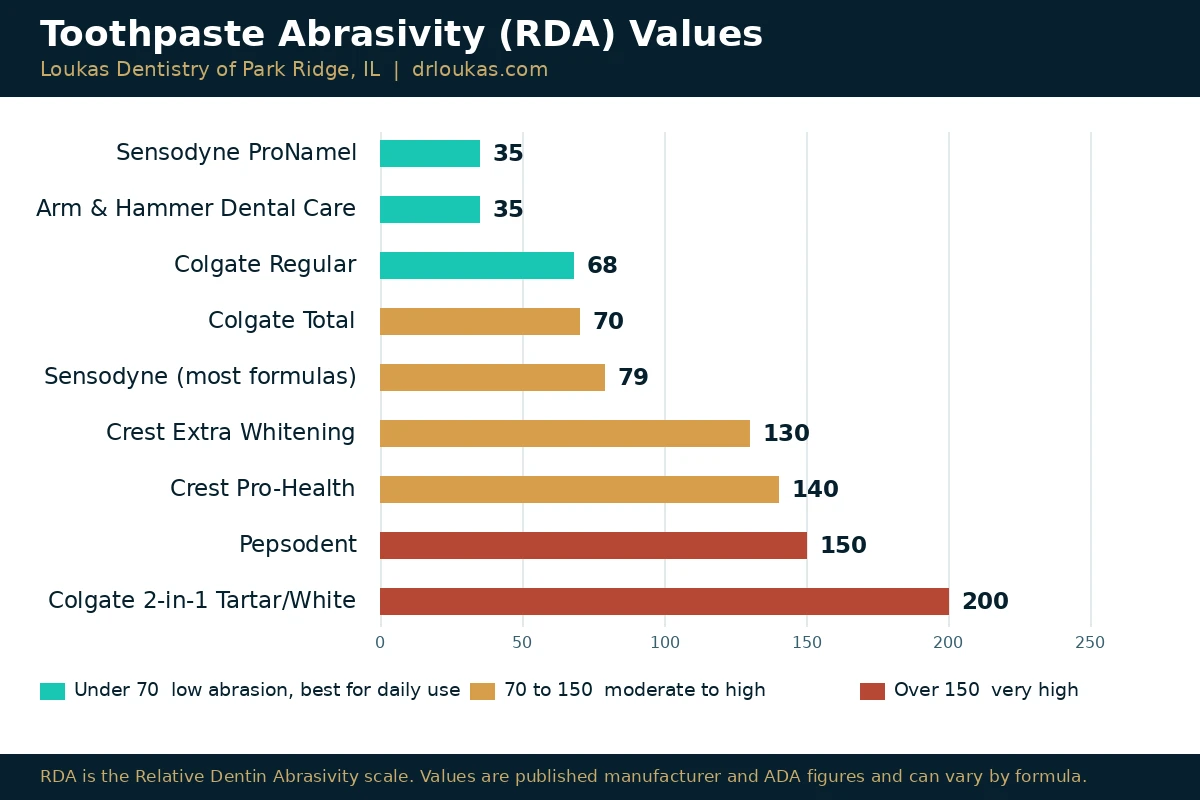
Every toothpaste is assigned an RDA score — Relative Dentin Abrasivity. This international standard measures how aggressively a toothpaste abrades dentin, the layer just beneath your enamel. The scale runs from 0 (no abrasion) to 250 (the upper limit the ADA considers acceptable for daily use).

  • RDA 0–70: Low abrasion — ideal for daily use, safe for sensitive teeth and exposed roots
  • RDA 70–100: Moderate — acceptable for most healthy adults
  • RDA 100–150: High — use with caution, especially if you have recession or sensitivity
  • RDA 150–250: Very high — not recommended for daily use by most dental professionals
Toothpaste RDA Score
Sensodyne (most formulas) 79
Colgate Regular 68
Colgate Total 70
Crest Extra Whitening 130
Crest Pro-Health 140
Pepsodent 150
Charcoal toothpastes (varies) 24–166
Colgate 2-in-1 Tartar/White 200

Clearing Up a Common Myth: Is It Bruxism or Toothpaste?

For decades, some clinicians attributed cervical notching to abfraction — the idea that bite forces and grinding flex the tooth at the gumline. But the science does not support it.

The 2017 AAP/EFP World Workshop on the Classification of Periodontal and Peri-Implant Diseases concluded definitively: “There is no credible evidence to support the existence of abfraction or implicate it as a cause of gingival recession.” (Fan J, Caton JG. Occlusal trauma and excessive occlusal forces. J Periodontol. 2019.)

The notches at your gumline are not from grinding. They are from your toothpaste and how you brush. That is actually good news — because it means the damage is entirely preventable.


The Real Damage: What High-RDA Toothpaste Does to Your Teeth

Abrasion damage is cumulative and permanent. Enamel does not grow back. Here is what happens over time:

1. Cervical abrasion. The gumline is where enamel is thinnest. High-RDA toothpaste wears through this thin layer and begins abrading the softer dentin beneath, creating a characteristic wedge-shaped notch at the base of the tooth.

2. Gingival recession. Abrasive particles and aggressive brushing force the gum tissue to pull back from the tooth, exposing the root surface — which has no enamel protection at all.

3. Sensitivity. Exposed dentin contains microscopic tubules that connect directly to the nerve. When exposed, hot, cold, sweet, and acidic foods can trigger sharp sensitivity.

4. Weakened tooth structure. Over years, repeated abrasion can compromise structural integrity, making teeth more prone to fracture.


The Whitening Toothpaste Trap

Whitening toothpastes are among the most heavily marketed — and among the most abrasive. The “whitening” effect is largely mechanical: abrasive particles scrub surface stains off. Over time, highly abrasive whitening toothpastes can actually make teeth look more yellow, as enamel wears away and the darker dentin beneath becomes more visible.

Charcoal toothpastes present a similar issue. Despite their “natural” marketing, many charcoal formulas have RDA values ranging from 90 to 166, with no clinical evidence of superior whitening.


What Dr. Loukas Recommends

For most patients, we recommend switching to a low-RDA toothpaste (under 70) for daily use:

  • Sensodyne ProNamel (RDA ~35): Specifically formulated to protect against acid erosion and abrasion.
  • Colgate Regular (RDA 68): A simple, effective formula without unnecessary abrasives.
  • Arm & Hammer Dental Care (RDA 35): Low abrasion with baking soda for gentle cleaning.

Brushing Technique Matters Just as Much

Even a low-RDA toothpaste can cause damage if you brush incorrectly. The most common mistake is horizontal scrubbing, which concentrates abrasive force directly at the gumline.

Dr. Loukas recommends the sweeping technique:

  • Upper teeth: Place the brush at the gumline and sweep downward toward the biting edge
  • Lower teeth: Place the brush at the gumline and sweep upward toward the biting surface
  • Always use a soft-bristled brush — medium and hard bristles dramatically increase abrasion risk

A Special Note on Electric Toothbrushes

Sonic brushes like the Philips Sonicare can be excellent tools when used correctly. Key guidelines:

  • Use an extremely light grip. The sonic vibration does the work — you are simply guiding the brush along the gumline. Do not press or scrub.
  • Move slowly from tooth to tooth, pausing briefly at each one. Do not replicate back-and-forth scrubbing.
  • Use a low-RDA toothpaste. High-frequency vibration can drive abrasive particles deeper into the tooth surface.

Rotary and spinning brushes (such as Oral-B oscillating-rotating heads) are not recommended by Dr. Loukas for patients with recession, sensitivity, or thin enamel. The mechanical rotation concentrates abrasive force in a circular pattern at the gumline, which can cause cervical damage over time.


When to See a Dentist

If you notice any of the following, schedule an appointment:

  • Sensitivity to cold, heat, or sweets that was not there before
  • Visible notching or grooves at the base of your teeth
  • Gums that appear to be receding
  • Teeth that look more yellow despite regular brushing

At Loukas Dentistry of Park Ridge, we assess every patient’s brushing technique and toothpaste choices as part of our routine exam. Small changes made early can prevent significant damage down the road.


References

  1. Dzakovich JJ, Oslak RR. In vitro reproduction of noncarious cervical lesions. Journal of Prosthetic Dentistry. 2008;100(1):1–10.
  2. Fan J, Caton JG. Occlusal trauma and excessive occlusal forces: Narrative review and clinical recommendations. Journal of Periodontology. 2019;90(Suppl 1):S166–S176. (2017 AAP/EFP World Workshop.)
  3. American Dental Association. Toothpastes: Relative Dentin Abrasivity (RDA) values. ADA Council on Scientific Affairs.
  4. Joiner A. Whitening toothpastes: A review of the literature. Journal of Dentistry. 2010;38(Suppl 2):e17–e24.

Have questions about your toothpaste or brushing technique? Call us at (847) 696-1919 or request an appointment online. We serve patients in Park Ridge, Niles, Des Plaines, Norwood Park, and the surrounding Chicago area.

Every toothpaste is assigned an RDA score — Relative Dentin Abrasivity. This international standard, established in 1995, measures how aggressively a toothpaste abrades dentin, the layer just beneath your enamel. The scale runs from 0 (no abrasion) to 250 (the upper limit the ADA considers acceptable for daily use).

Here is the problem: the ADA’s “safe” ceiling of 250 is far higher than what most dentists would actually recommend for daily use. For context:

  • R

Invisalign in Park Ridge, IL, A Complete Guide from Loukas Dentistry

Your Guide to Invisalign in Park Ridge, IL

▶ Watch Invisalign Results

If you want a straighter smile without the look and feel of traditional braces, Invisalign clear aligners may be one of the most comfortable and convenient choices available. At Loukas Dentistry in Park Ridge, IL, we help adults and teens understand whether clear aligner treatment fits their bite, smile goals, lifestyle, timeline, and budget. Our goal is not to rush you into treatment, it is to give you honest guidance, careful diagnosis, and a plan that makes sense for your teeth.

Invisalign treatment uses a series of removable, clear aligners that are planned digitally and worn in sequence. Each aligner places gentle pressure on selected teeth so movement can occur gradually. Because the aligners are removable, patients can eat normally, brush and floss more easily, and smile with confidence during treatment. For many Park Ridge patients, that balance of appearance, comfort, and control is the main reason they ask about Invisalign at Loukas Dentistry.

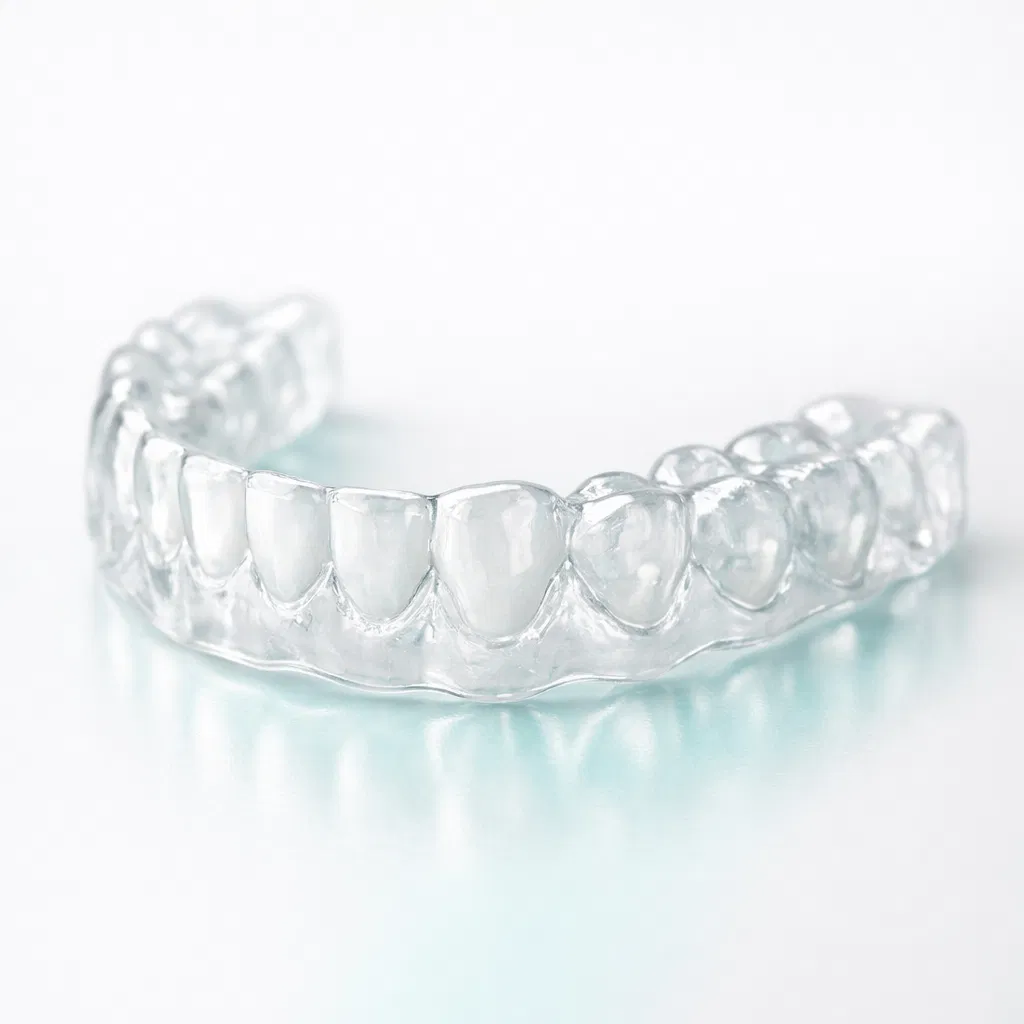
Clear transparent dental aligner tray curved to fit over teeth, resting on a reflective white surface.
Clear, custom-fit Invisalign aligners at Loukas Dentistry in Park Ridge, IL.

Why Patients Choose Invisalign at Loukas Dentistry

Every Invisalign case begins with a conversation. We listen to what bothers you about your smile, how long it has been a concern, and what kind of result would feel worthwhile to you. Some patients want to close spaces. Others want to correct crowding, improve rotated teeth, or create a more balanced smile before cosmetic dentistry. Some patients simply want to feel more confident in photos, at work, or at family events.

Dr. Thanasi Loukas and Dr. Maria Loukas approach orthodontic planning with the broader health of the mouth in mind. Tooth movement should be evaluated in relation to gum health, tooth wear, bite forces, restorations, jaw comfort, and long term maintenance. This is especially important for adults who may have existing crowns, veneers, implants, gum recession, or a history of grinding. A beautiful smile should also be a stable smile.

Invisalign clear aligner consultation at Loukas Dentistry in Park Ridge IL

What Invisalign Can Help Improve

Invisalign may be recommended for mild to moderate crowding, spacing, rotated teeth, narrow smile appearance, minor bite concerns, and certain relapse cases after previous orthodontic treatment. It can also be part of a larger cosmetic or restorative plan when tooth position needs to be improved before veneers, bonding, implants, whitening, or bite rehabilitation. Not every case is best treated with aligners, and that is why a consultation matters.

During your evaluation, we look at how your teeth fit together, whether enough space exists for safe movement, how your gums and bone support your teeth, and whether any dental work should be completed before aligners begin. If Invisalign is a good option, we explain the steps clearly. If a different approach would be healthier or more predictable, we will tell you that as well.

The Loukas Dentistry Invisalign Process

Your Invisalign visit usually begins with photographs, a dental examination, a bite review, and digital records. Our office uses modern technology to help plan treatment with accuracy. Digital scanning can reduce the need for traditional impression material, and it allows us to evaluate your smile in a more visual way. Patients often appreciate seeing how small tooth movements can contribute to a larger improvement.

Once a treatment plan is approved, your aligners are made and delivered in a series. You wear each set as directed, remove them for meals and brushing, and return for progress checks. Compliance is important. Invisalign works best when aligners are worn consistently, kept clean, and changed on schedule. Our team gives practical tips so treatment can fit into daily life without unnecessary stress.

Invisalign for Adults in Park Ridge

Many adults want orthodontic improvement but do not want metal brackets in professional or social settings. Invisalign can be a discreet option for teachers, business owners, healthcare professionals, parents, students, and anyone who wants a less noticeable way to improve tooth position. Adults also tend to appreciate that aligners can be removed for important events, although they must still be worn enough hours each day for predictable movement.

Adult Invisalign planning requires attention to details that are not always present in younger patients. Existing fillings, crowns, gum recession, tooth wear, implants, and TMJ concerns can all influence treatment. Loukas Dentistry evaluates these factors carefully so aligner therapy supports the whole mouth, not just the visible front teeth.

Invisalign for Teens and Young Adults

Clear aligners can also be appropriate for responsible teens and young adults who can wear them consistently. For families in Park Ridge, Niles, Des Plaines, Rosemont, Edison Park, Norwood Park, and the Chicago Northwest Side, Invisalign may be appealing because it allows easier brushing, fewer food restrictions, and a more natural appearance during school, sports, photos, and social events.

Parents often ask whether Invisalign is easier than braces. The answer depends on the patient. Aligners require discipline because they can be removed. Braces are fixed in place, so they do not depend on the same level of daily compliance. We help families compare both choices honestly before deciding.

Close-up of a confident smile after Invisalign treatment at Loukas Dentistry

How Invisalign Fits with Cosmetic and Restorative Dentistry

One reason Invisalign is valuable in a comprehensive dental office is that tooth position affects many other procedures. If teeth are crowded or tilted, veneers may require more tooth preparation. If teeth are unevenly spaced, bonding may be less symmetrical. If the bite is unstable, crowns and restorations may experience extra stress. Moving teeth first can sometimes make later cosmetic or restorative treatment more conservative and more natural looking.

At Loukas Dentistry, Invisalign can be coordinated with whitening, bonding, porcelain veneers, crowns, dental implants, and preventive care. The sequence matters. In many cases, tooth movement happens first, then whitening, then final cosmetic shaping or restorative work. That type of planning helps the final result look intentional rather than patched together.

Real Invisalign Results at Loukas Dentistry

See real Invisalign results from patients at Loukas Dentistry of Park Ridge.

Invisalign before and after with whitening result
Before & After: Invisalign treatment paired with teeth whitening for a brighter, more even smile.
Invisalign straight smile before and after
Before & After: Beautifully straight teeth achieved without metal braces.
Invisalign before and after with cosmetic refinement
Before & After: Invisalign treatment combined with cosmetic bonding for a refined, uniform smile.
Invisalign complete smile transformation
Before & After: A complete smile transformation with Invisalign.
Invisalign final result
Final result after Invisalign treatment closed a gap between the front teeth, creating an even, confident smile without metal braces.

What Makes Loukas Dentistry Different

Loukas Dentistry is a family dental practice with a long history in Park Ridge. Dr. Maria Loukas has been practicing since 1981, and Dr. Thanasi Loukas returned to Park Ridge in 2006 after attending Tufts University in Boston, Massachusetts, to join his mother in private practice. Together, they bring experience, continuity, and a patient centered viewpoint to every treatment plan.

Our philosophy is simple. We want patients to understand their options, feel respected, and receive dentistry that is technically careful and personally thoughtful. Invisalign is not just a cosmetic service. It is part of how the teeth, gums, bite, and smile work together. That is why our recommendations are based on diagnosis, not sales pressure.

Frequently Asked Questions About Invisalign in Park Ridge

How long does Invisalign take?

Treatment time depends on the complexity of the case, how much movement is required, and how consistently aligners are worn. Some limited cases may be shorter, while more involved cases may take longer. We review your estimated timeline during your consultation.

Is Invisalign painful?

Most patients describe pressure or tightness when they start a new aligner, especially during the first day or two. That sensation usually means the aligner is working. It should not feel sharp or traumatic. If something feels wrong, our team can evaluate the aligner and your bite.

Can I eat with Invisalign?

No. Aligners should be removed for eating and for drinking anything other than water. This protects the aligners, reduces staining, and helps prevent food from being trapped against the teeth.

Do I still need cleanings during Invisalign?

Yes. Cleanings and checkups remain important. Healthy gums and clean teeth support better orthodontic movement and help prevent inflammation during treatment.

Schedule an Invisalign Consultation in Park Ridge

If you are considering Invisalign in Park Ridge, IL, Loukas Dentistry can help you decide whether clear aligners are right for you. Want to learn more first? Watch our Invisalign results video or read Invisalign vs. braces to see which option may fit you best. We welcome patients from Park Ridge, Niles, Des Plaines, Rosemont, Edison Park, Norwood Park, and the Chicago Northwest Side. Call (847) 696-1919 or request a visit through our contact page.


Park Ridge October Event: Spirits of Old Park Ridge Tour

cemFall is an exciting time of year. The leaves are changing and there is a bite in the air. Halloween is coming up, and the holidays are right around the corner. If you’re looking for something cool to do, your Park Ridge dentists, Drs. Maria and Thanasi Loukas suggest taking the Spirits of Old Park Ridge tour of the Town of Maine cemetery.

(more…)

Oil Pulling

oilpullOil pulling has been a hot topic. Although an ancient Ayurvedic ritual, Dr F. Karach, MD introduced it into our modern culture in 1992 claiming that it could cure heart disease, digestive disorders, hormonal imbalances, and a host of other conditions. For people who prefer to use natural ingredients this was good news, but what is the real scoop on oil pulling? Today your Park Ridge dentists, Drs. Maria and Thanasi Loukas discuss oil pulling.

(more…)

To Keep or To Extract your Wisdom Teeth?

Smiling Middle aged CoupleDo you still have your wisdom teeth in your mouth? Or were they long ago extracted and forgotten about. Either way, they have nothing to do with your intelligence, but they can make the difference between healthy aligned teeth, or crowded, gapped, overlapped, or infected ones. There has been some controversy over the years as to whether or not dentists have become “extraction happy” with wisdom teeth. Are your third molars being removed preventively – a sort of “just in case” – rather than for true need?

Unwise Conceptions

While statistics have guessed that as many as 70% of people will end up with wisdom teeth issues, these numbers tend to be more opinion based. Equal statistics and studies can be found claiming that the number of people that actually have trouble or truly need their wisdom teeth removed are probably much less of a percentage. In the United Kingdom, the National Health Service does not pay for wisdom teeth extraction, believing it to be elective rather than necessary in the majority of cases. Our proactive efforts in the United States may be overkill, as the Cochrane Collaboration collected data showing that wisdom teeth removal could probably be dropped into the 60% range if people waited until they had actual problems with their third molars. (more…)

Suggestions for Freshening your Breath

Kiss on DateDo you have a hot date this weekend? Whether it is your first official date, or you’ve been married for 45 years, one thing is for sure, fresh breath should be an important goal any time you are out with someone you adore. If you want to make sure that you’re ready for your goodnight kiss this evening, read on to get fresh breath tips from Park Ridge dentists, Drs. Maria and Thanasi Loukas.

Tip #1: Brush and Floss Your Teeth

Okay, maybe this is obvious, but life gets busy and daily habits are easy to ignore. Perhaps you’ve been spending so much time trying to plan the perfect date, you have stressed yourself out and neglected your oral hygiene routine. Make sure you brush at least twice-a-day, and floss daily. Those stubborn bacteria that hide between your teeth can get trapped along with food particles and cause plaque buildup and bad breath.

Tip #2: See Your Dentist Every Six Months

(more…)

Can Loose Permanent Teeth Be Save?

Loose Tooth GuyYour natural, healthy teeth consist of two main parts: the crown (top part) which is the only visible part of a tooth above the gumline. Under the gumline, roots continue, embedded in a socket within your jawbone along with other nerves and tissues. This is known as dental pulp. Roots offer your teeth the structural support needed to bite and chew every day. Each tooth has one to four roots and is held in its socket by strong periodontal tissues. When these tissues are damaged by trauma or infection, your teeth can become loose and move around in their sockets. If treatment isn’t sought promptly, then you’re loose teeth may be lost and require replacement. Fortunately, with quick action, Park Ridge dentists, Drs. Maria and Thanasi Loukas can help you preserve your natural smile by addressing loose teeth before they are completely lost.

Dental Trauma

The two most common reasons for teeth to become loose are periodontal (gum) disease and direct traumatic impact. There are many possible causes for trauma. If you lose your balance and fall, or if you are hit in the mouth during a contact sport or physical altercation, the force of the trauma can damage (more…)

Several Options for Restoring Missing Teeth

couple2Have you lost one or more of your adult (permanent) teeth? If so, you understand the difficulties which can arise when teeth meant to stay with you through the course of your life are suddenly lost. Thankfully, restorative dentistry options are designed to replace missing teeth with aesthetically pleasing and functional prosthetic replacements. To learn more about restorative dentistry and your tooth replacement options,  Park Ridge dentists, Dr. Maria Loukas and Dr. Thanasi Loukas, are here for a consultation whenever you are ready.

Dentures

When all of your teeth have been lost, dentures are a common way to fill the void. Dentures can expand your face in the same way that natural teeth do, reversing physical signs of aging that accelerate when teeth are lost. Dentures also provide the teeth necessary to break down food, aiding in your body’s digestive processes. If you are only missing some teeth in a row, but not al of them, partial dentures are another option. Partial dentures are custom made for patients to fill in the gaps in a smile. By wearing a partial denture, you can restore your smile and help protect your remaining teeth by guarding their exposed sides with prosthetic teeth.

Dental Bridges

Dental bridges are used to fill in a single gap. The gap may be made up of one or more lost teeth. Dental bridges are held steady by two dental crowns located on either end of the bridge. These crowns fit over the teeth that sit on the edges of the gap that will be bridged. (more…)

Can Dental Implant Patients Contract Gum Disease?

des-plaines-dentistTooth loss may seem like a worst case scenario for patients with advanced gum disease (periodontitis). However, the truth is that the disease can even prevent the success of your replacement teeth if not treated and controlled properly. Gum disease attacks the gums and jawbone that support your smile, eventually causing one or more teeth to fall out or require extraction. Even after teeth are lost, the inflammation associated with gum disease can continue to cause damage if not treated. Park Ridge general dentists, Drs. Maria and Thanasi Loukas, specialize in replacing lost teeth and restoring patients’ ability to bite, chew, and smile confidently. They also have extensive experience treating advanced gum disease, the leading cause of adult tooth loss.

Periodontal Disease

Gum disease begins with a phase called gingivitis (bacterial infection in your gums) which results from excessive plaque buildup. Plaque is made of over 600 different kinds of oral bacteria. As the infection sets in, your gums become red and swollen (inflamed), often bleeding when you brush your teeth. The rampant inflammation and toxins released by certain germs may cause your gum tissue to recede from your teeth, creating pockets that can hold more bacteria and accelerate the disease. Left untreated, gum disease can destroy your gums and the jawbone underneath until they can no longer support your teeth.

Gum Disease for Dental Implant Patients

Dental implants are small root devices that are surgically inserted into the jawbone to replace the roots of your missing teeth. Once an implant is inserted, the jawbone begins fusing to its biocompatible titanium surface as it heals. Before implants can be placed, however, Dr. Loukas will ensure that your mouth is free of infection, especially if you’ve lost your teeth to gum disease. If not controlled, or if gum disease develops again after you’ve received your dental implants, then the infection can degrade your jawbone and cause the implant(s) to fail.

About Dr. Maria and Dr. Thanasi Loukas:

Whether you wish to protect your smile from dental disease and damage, or restore your smile after suffering tooth loss, we can help you regain your oral health and confidence through a new and improved smile. Dr. Maria and Dr. Thanasi Loukas are highly-skilled restorative and cosmetic dentists serving the Park Ridge and surrounding Chicago communities. To schedule an appointment, call Loukas Dentistry of Park Ridge today at (847) 696-1919.

Ready to Brush Up on Oral Hygiene

Brushing Teeth Young LadyThe feeling of clean, smooth teeth is a terrific one. When the sticky biofilm better known as plaque (and its hardened form, tartar) clings to your teeth and builds up, you can feel the disconcerting roughness on your tongue. If these bacteria-laden biofilms are not cleaned off on a regular basis, they can lead to cavities and periodontal (gum) disease. You owe it to yourself to visit your dentist every six months for cleanings and checkups. In between time, your own meticulous oral hygiene is very important.  Park Ridge dentists, Dr. Maria and Thanasi Loukas will share more information about the basics of brushing your teeth.

Choosing a Toothbrush

With so many price ranges and choices on the market, the question is not so much “what is the best toothbrush to purchase?” Rather, you may want to ask yourself “which type of toothbrush will most inspire you to stick to your regular brushing routine?” The bigger priority is not procuring the best toothbrush on the market, but maintaining consistency with your oral hygiene routine which will keep your smile in the best possible condition between your six month checkups. Here’s a rundown of the two basic types of toothbrushes on the market: (more…)